English
 русский
 简体中文
简体中文


Metal Sawing: Production Know-How
Pneumatic Automatic Steel Pipe Sawing Machines: The Practical Buyer's Guide
A pneumatic pipe saw is dependable until the air supply, the blade or the clamping system lets it down. This guide explains how these machines work, where they genuinely fit, and what to check before you buy.
At eight in the morning, a 60 mm hydraulic cylinder tube moves into the clamping jaws of the shop's pneumatic automatic saw. One button press, and the pneumatic circuit clamps the pipe, advances the blade and returns the head. For the first two hours the rhythm is clean: square ends, small burrs, a neat stack of blanks. By mid-afternoon the cycle slows, the lower edge of the cut starts tearing, and the operator reads the air gauge more often than the workpiece. The machine did not suddenly fail; the shop simply outgrew the assumptions built into its air supply.
The conclusion is worth stating early: a pneumatic automatic steel pipe sawing machine is a low-cost, dependable production tool when three conditions hold — adequate air volume, a blade matched to the wall thickness, and a clamping system that grips the pipe on both sides of the saw path. When any one of those slips, the machine starts deciding your quality.
What a Pneumatic Automatic Steel Pipe Sawing Machine Actually Does
"Pneumatic" means the machine uses compressed air to drive the mechanical functions around the cut — typically the horizontal clamp, the vertical clamp, and sometimes the material stop or the blade feed. The saw blade itself is driven by an electric motor; the pneumatic system sequences the cut cycle.
A typical automatic cycle looks like this:
- The pipe advances to a length stop.
- A pneumatic cylinder closes the horizontal clamp against the pipe.
- A second cylinder applies vertical pressure just behind the cut line.
- The saw head feeds forward and completes the cutting stroke.
- The head returns, both clamps release, and the finished piece drops to the discharge table.
- The next piece advances and the cycle repeats.
"Automatic" in this context means repeatable, not necessarily accurate. The machine removes the operator's influence from clamping pressure and feed timing, but it still depends on a stable air supply. Most machines are rated for 0.4 to 0.6 MPa at the inlet. If the compressor cannot hold that pressure during the clamping and feeding stroke, every cycle runs longer and the blade pushes instead of cuts.
Air consumption is a design criterion, not a footnote. A pneumatic pipe saw cycling eight to ten times per minute can draw 120 to 180 litres of free air per minute, and few shops have only one pneumatic machine. Size the compressor, the receiver tank and the line diameter before the saw arrives.
Where Pneumatic Pipe Sawing Machines Fit Best
In practice, pneumatic pipe saws earn their keep in three situations:
- Single-diameter repetition. When the same tube size and wall thickness run for whole shifts, the pneumatic cycle applies identical clamp pressure and timing to every piece.
- Angle cutting for frames and handrails. Machines with a pivoting head or a rotary table repeat the same mitre cut for structural and architectural steel work.
- Short-batch production in fabrication and maintenance shops. Changeover is quick, the machine is easy to understand, and the capital cost stays far below a CNC installation.
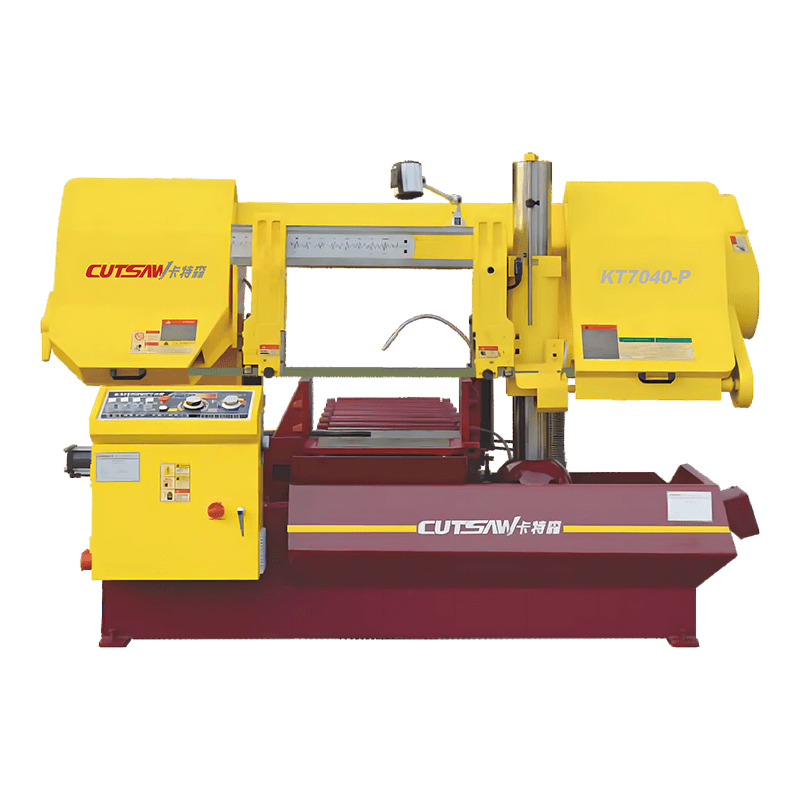
The limits are just as clear. Very high volumes outrun the cylinder speed; very low volumes make the length-stop setup feel wasteful; and thick-wall pipe — roughly beyond an 8 to 10 mm wall — demands a feed force that a pneumatic cylinder cannot hold constant across the width of the cut. For shops that want a band saw dedicated to pipe work, a semiautomatic hydraulic pipe-cutting band saw such as the KT7040P removes air-pressure sensitivity from the clamping equation entirely.
Most pipe sawing problems are not blade problems. They are clamp and pressure problems. If the pipe can move while the blade is cutting, no blade will fix the finish. — Maintenance lead, metal fabrication shop
Pneumatic vs Hydraulic vs Servo: What Changes in Production
The machine class matters less than the behaviour of the feed force. The table below compares the three common architectures for automatic pipe and bar sawing. Tolerances are shop-floor references, not manufacturer guarantees.
| Characteristic | Pneumatic cylinder | Hydraulic system | Servo / CNC drive |
|---|---|---|---|
| Feed force behaviour | Varies with air pressure and load | Constant, adjustable force | Programmable torque and feed rate |
| Cut stability | Moderate; sensitive to pressure drops | Good | Excellent |
| Blade life | Depends on air consistency | Predictable | Most consistent at high uptime |
| Energy and maintenance | Low energy; service FRL units | Oil and pump maintenance | Higher first cost; low running cost |
| Typical length tolerance | +/-0.5 to 1.0 mm | +/-0.2 to 0.5 mm | +/-0.1 to 0.3 mm |
| Best fit | Short and medium runs, thin to medium wall | Heavy, large-diameter and long runs | Multi-diameter batches, angle programs, unattended operation |
The point is not to reject pneumatics. It is to match the machine architecture to the cut list. A pneumatic automatic steel pipe sawing machine is often the correct first machine; a servo-fed band saw is often the correct second machine. Many shops run both.
Five Checks Before You Buy a Pneumatic Automatic Steel Pipe Sawing Machine
- Audit the air infrastructure first. Confirm compressor capacity, receiver volume, dryer, filter-regulator-lubricator units and line diameter. A machine that needs 0.4 to 0.6 MPa at the inlet will not perform on a line that drops below 0.45 MPa under load.
- Inspect the clamping layout. The machine should hold the pipe on both sides of the saw path. Single-clamp designs let the pipe vibrate during breakthrough and raise burrs on the exit edge. Check jaw length and clamping stroke against your full pipe OD range.
- Look at the saw head, not the sticker. Frame stiffness, guide beam width, blade wheel size and gearbox quality determine performance more than the motor rating. A large motor bolted to a light frame will not cut straight.
- Confirm that feed speed is adjustable. You need rapid advance to the pipe, controlled feed through the wall, and a fast return. A single-speed feed makes it harder to adapt to different wall thicknesses.
- Verify safety and compliance documentation. CE marking, blade guard, interlocked covers, an emergency stop and a proper manual. Ask for the documents before you ask for the price.
A larger motor rating than the frame can structurally support is a red flag, not a benefit. The mass of the saw head, the width of the guide beam and the quality of the castings decide cutting performance over the life of the machine.
Never operate a pipe saw without a functional blade guard and emergency stop. Pneumatic cylinders can fail in either position, so the guard is the second line of defence. Equipment without CE documentation should be excluded regardless of price.
Blade Selection, Burrs and the Cuts That Fail Inspection
Steel pipe is an interrupted cut: the blade passes through two walls and an empty centre, which makes tooth pitch more important than blade speed. A practical rule is to keep at least three teeth in contact with the wall at any moment. For typical pipes with 3 to 8 mm walls, a variable-pitch bimetal blade in the 4/6 or 5/8 teeth-per-inch range is a common starting point; thin-wall tube needs a finer pitch, around 10/14 TPI, to avoid tooth stripping.
Most cutting defects trace back to the same root causes. Uneven cutout usually means blade wander from worn guides, excessive feed pressure or a dull blade. Exit burrs mean the far-side clamp is too weak. Deformed pipe ends mean the vertical clamp is crushing the tube before the cut begins. For circular saw machines the same physics applies; the practical adjustments are covered in our guide on how to solve the uneven cutout of metal circular saws.
Blade life on a pneumatic machine is also an air-supply issue. If the feed cylinder pushes harder as line pressure climbs at the end of the compressor cycle, the teeth load unevenly and flat spots appear. Slowing the feed just before breakthrough is the single most effective habit for extending blade life.
When Pneumatics Are Not Enough: Realistic Upgrade Paths
Every pneumatic pipe saw eventually meets its workload ceiling. The upgrade decision should come from the cut list, not from sales pressure. Three patterns are common:
When Volume Outgrows a Single Shift
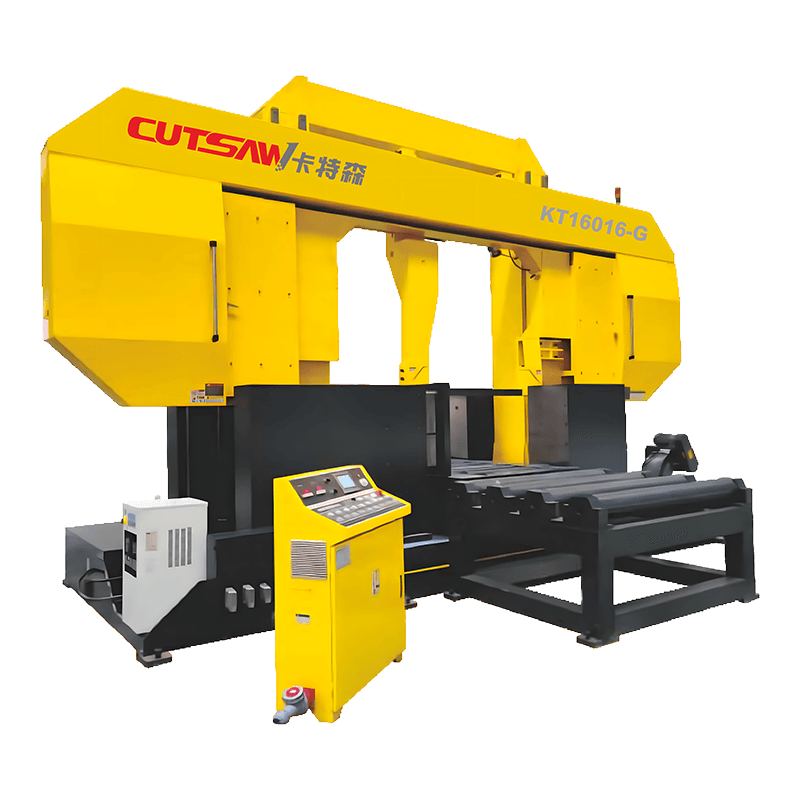
A hydraulic double-column saw removes the air-pressure dependency and runs continuously with predictable blade life. For large diameters and heavy walls, the double-column construction keeps the head from twisting; the ultimate guide to double-column band sawing machines explains the structural reasons in detail.
When the Customer Wants a Milled-Looking End Face
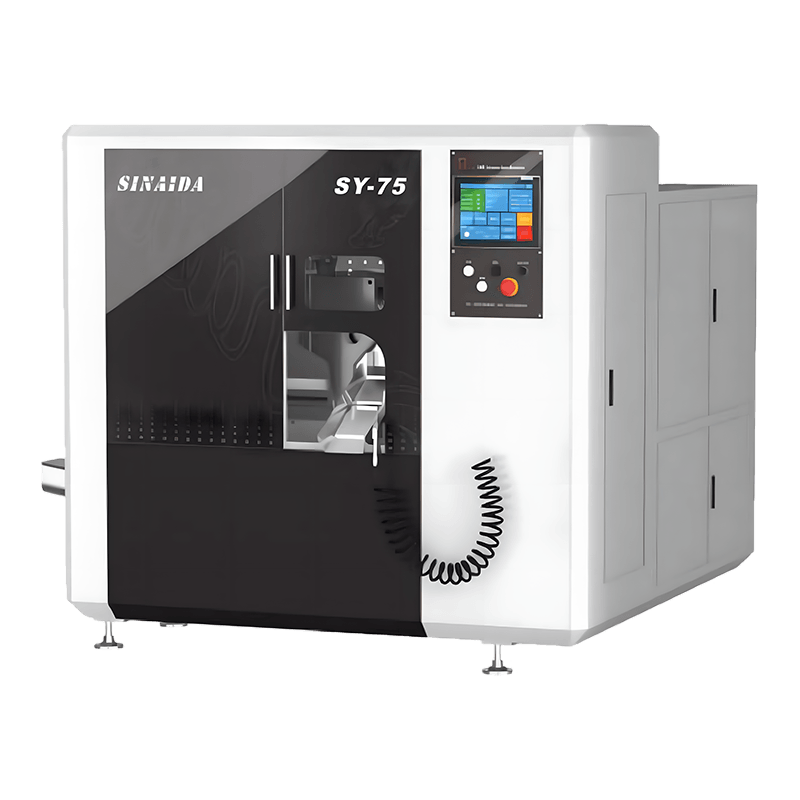
A carbide-tipped circular saw produces a cleaner, flatter surface on round steel, tube and stainless bar in a shorter cycle than a band saw. Machines such as the SY75 are designed for exactly this mix of round stock and pipe.
When Batch Sizes Shrink and Diameters Multiply
Setup time starts to dominate. A machine with programmable length stops and stored feed recipes becomes more attractive than any fixed-cycle pneumatic machine.
Automation-Ready Machines: The Step After the Pneumatic Saw
Automation readiness means the machine can reproduce a program without relying on the operator's hand and eye. A pneumatic automatic steel pipe sawing machine is automatic in the sense that it sequences a fixed cycle; a servo-fed CNC band saw reproduces the same length, angle and feed profile across hundreds of pieces, and switches programs when a new diameter arrives on the rack.
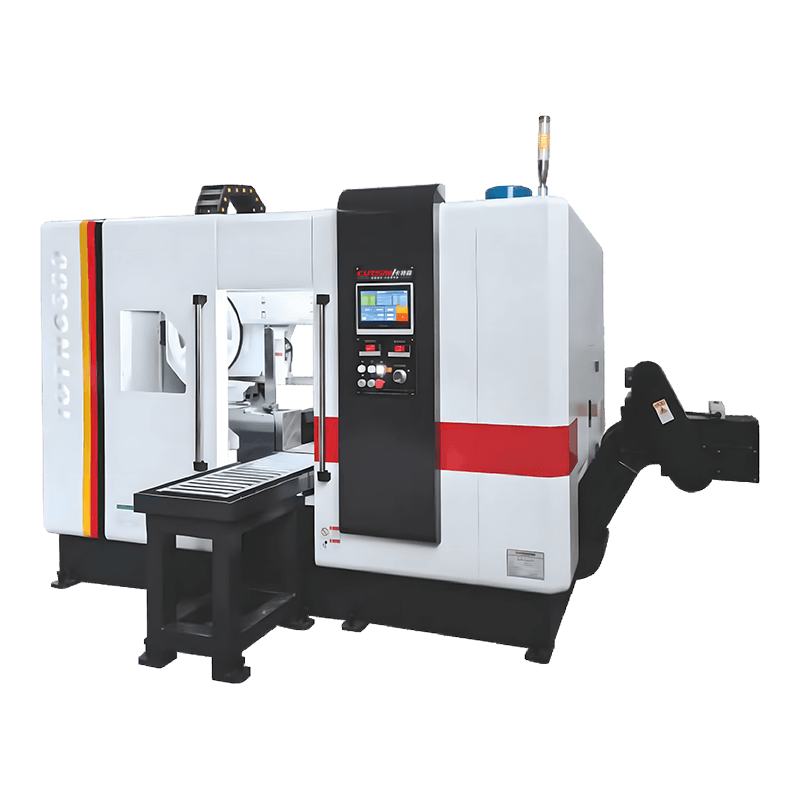
That distinction matters when the cut list becomes more varied rather than more repetitive. An automatic-feed CNC band saw such as the KT330Z brings a linear bar feed, automatic clamping and programmable cutting length into a compact frame — a natural long-run machine beside an existing pneumatic saw, which keeps handling short runs and odd diameters.
We kept the pneumatic saw for short runs and moved the high-volume work to a hydraulic machine. Blade consumption dropped by a third within two months. — Production manager, steel furniture plant
What a Serious Supplier Should Be Able to Show You
Brochures describe the machine; the workshop defines it. Ask the supplier to run a test cut on your actual pipe grade and wall thickness and record the end-face quality and cycle time. Ask for the air consumption figure in litres per minute, not just a pressure rating. Confirm the clamping stroke against the full range of pipe diameters you intend to cut.
Manufacturers with a complete line — from semiautomatic hydraulic saws to servo-driven CNC models — can usually advise honestly about which architecture fits, because they are not limited to one machine type. ISO 9001 and CE documentation are entry requirements, not differentiators.
Before you sign: run a test cut on your material, confirm compressor capacity, check clamp stroke against your pipe range, request the manual and CE declaration, and verify spare-part availability and blade delivery time.
Choose the machine whose air, blade and clamping conditions are designed as one system. Start from the cut list rather than the brochure: count the daily cuts, measure the wall thickness, and test the compressor before comparing prices. Do that, and a pneumatic automatic steel pipe sawing machine will earn its floor space — and the next machine you buy will be an upgrade rather than a repair.