English
 русский
 简体中文
简体中文


The Components of a Metal Band Sawing Machine, Explained Part by Part
Frame, saw head, drive, guides, tension, vise, coolant and controls — a component-by-component walkthrough for buyers and operators, written from the shop floor rather than the catalogue.
Most faults that get blamed on the operator are component faults. When a cut drifts out of square by half a millimetre across a 200-millimetre bar, the usual culprits are worn blade guides, guide arms set too far from the workpiece, or a saw head descending under uncontrolled force. When blades snap weeks earlier than they should, the trail leads to tension, coolant or tooth pitch — almost never to a careless machinist.
That is the practical reason to learn these components: every performance figure on a quotation — squareness, blade life, finish, cuts per hour — is produced by one part doing one job. Walk any machine in a fixed order, ask one pointed question about each part, and its real capability shows long before the first test cut.
Frame and Saw Head: Where Rigidity Is Decided
The frame is the machine's reference. A welded, stress-relieved steel bed carries the vise, supports the workpiece and absorbs the vibration that would otherwise telegraph into the cut face. If the frame flexes, no blade will hold squareness on heavy sections.
Above the bed sits the saw head — the housing that carries both wheels, the blade guides and the drive. How that head moves separates the main machine families:
- Scissor (pivot) machines: the head swings on one hinge — simple and affordable, for lighter, intermittent cutting.
- Double-column machines: the head travels on two linear guide columns, keeping blade pressure even across the workpiece width; the standard for heavy, accurate cutting.
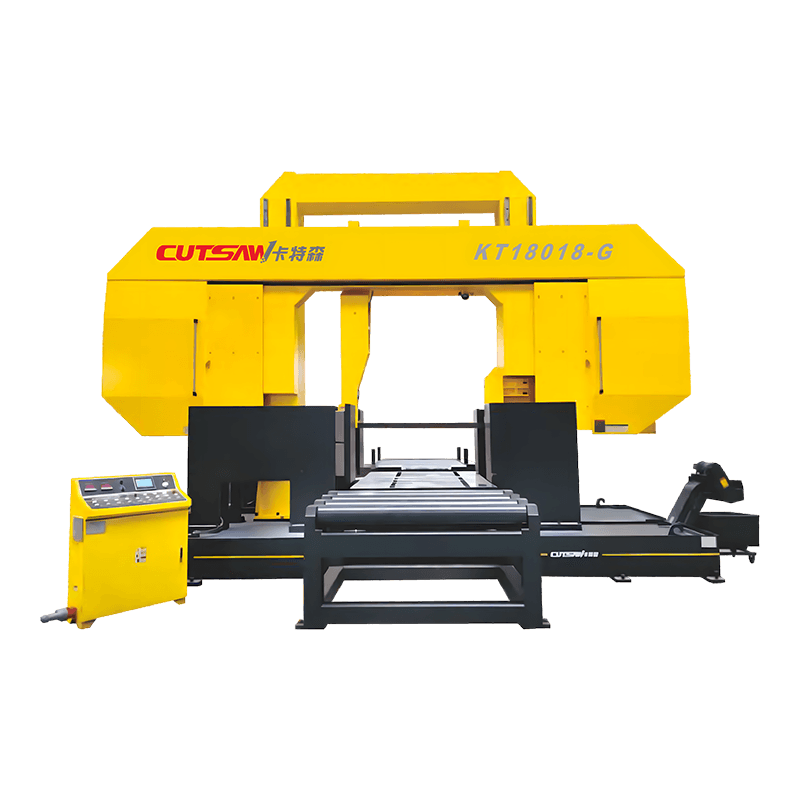
- Gantry machines: a portal frame spans the workpiece, and the saw travels over very large cross-sections.
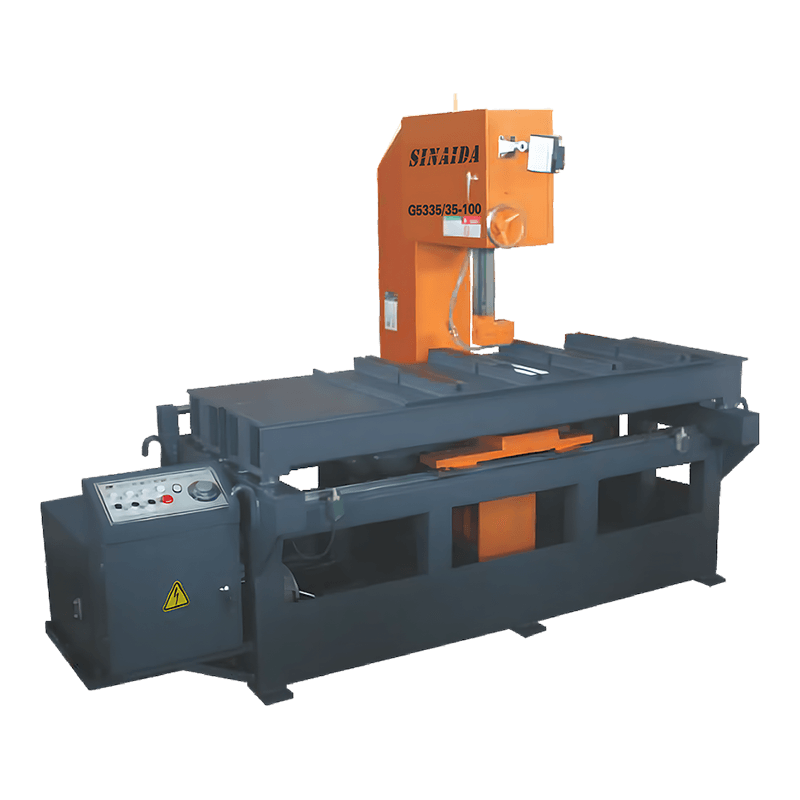
- Vertical machines: the blade runs through a worktable for long stock, contours and plate.
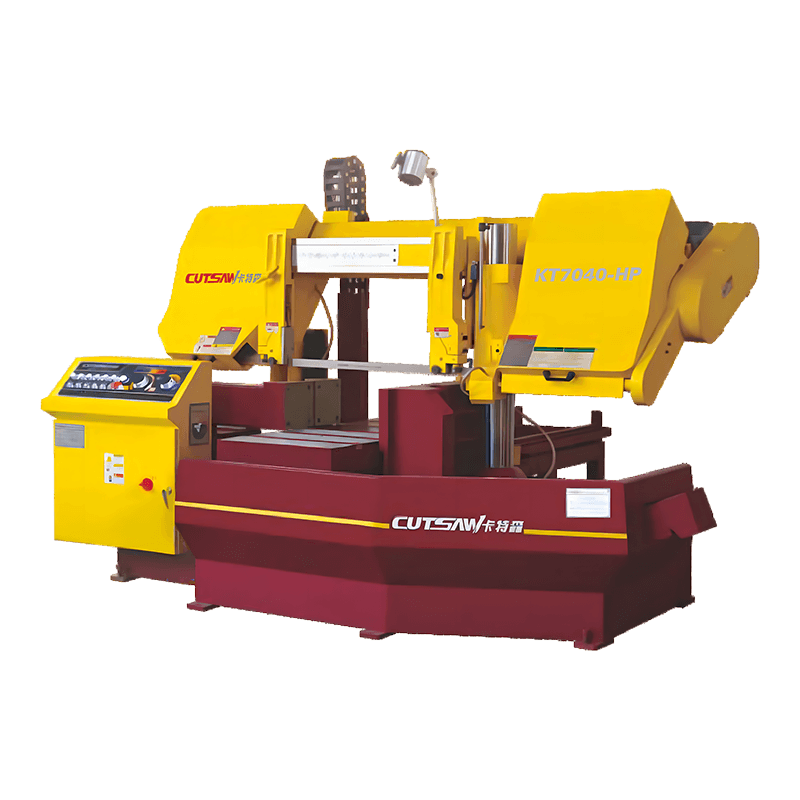
Column rigidity earns its price wherever cutting forces are highest: a rigid twin-column head holds feed pressure identical from first tooth to last, while a flexing hinge head lets the blade wander as a heavy cut deepens. The machine below was built for exactly that duty.
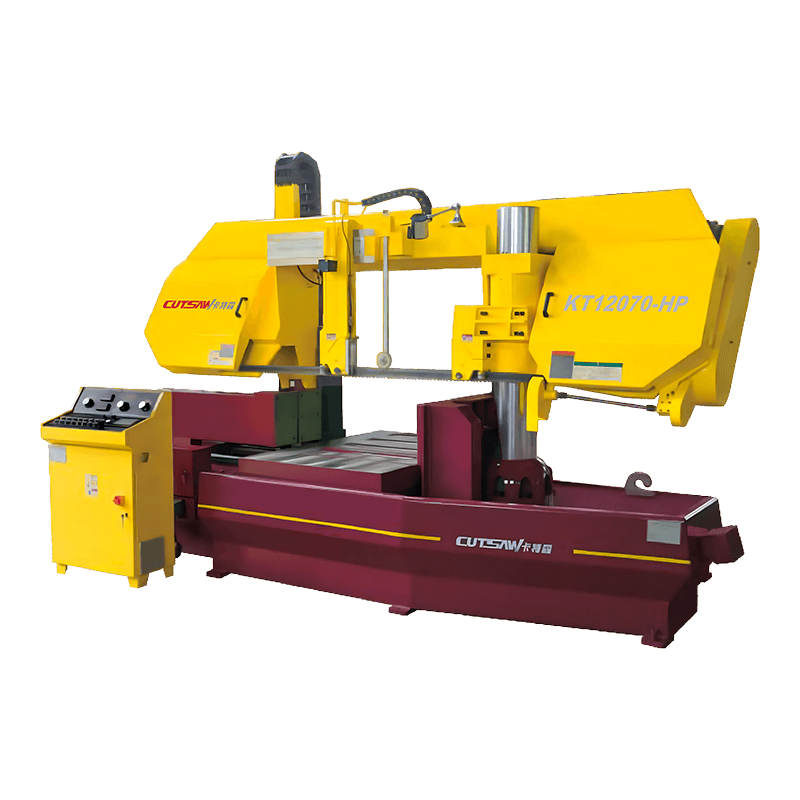 KT12070-HP Heavy-Duty Dual Column Band SawA twin-column head keeps feed pressure constant under heavy cutting loads, which is exactly the duty described just above. Rigid dual-column construction and a stable worktable make it worth a look where blade wander and flexing frames are the concern.View Product →
Our guide to double-column band sawing machines covers these frame types in more depth.
Drive System: Motor, Wheels and Blade Speed
Two wheels close the blade's loop. The lower drive wheel is powered through the gearbox; the upper idler wheel tracks the blade and carries the tensioning hardware. Between them, the transmission — usually a worm gearbox on metal-cutting machines — multiplies torque and holds blade speed steady under a full load.
What matters when comparing machines is the speed range, not just the motor rating. Bi-metal blades on mild steel typically run near 60-80 metres per minute, stainless steel wants markedly less, and aluminium wants several times more. A variable-frequency drive lets one saw serve all three correctly; a fixed-speed machine quietly sacrifices blade life or finish on whichever material it was never tuned for.
Blade, Guides and Tensioning: The Accuracy Triangle
The blade is itself a component: a continuous loop of bi-metal or carbide-tipped steel, chosen by tooth pitch so at least three teeth remain engaged in the cut. But the blade only performs if its two supporting components are right.
Blade guides — carbide pads or roller assemblies on adjustable guide arms — hold the blade beam upright directly above the cut. Worn guides, or arms spaced too far apart, let the blade twist; the evidence is drift, bevelled faces and early tooth chipping. Blade tensioning keeps the band rigid between the wheels: hydraulic tensioning holds a set value automatically, while manual tension depends on the operator's attention.
A band saw is a tensioned, guided, continuously cooled loop of steel. When cutting quality collapses, the cause is almost always tension, guidance or heat — in that order.
Worktable, Vise and Material Support
Clamping decides squareness as much as any guide. The vise must hold the workpiece rigid against cutting torque, and hydraulic vises do it with consistent force on every cycle — one reason they are standard on automatic machines. On CNC models, the vise itself moves to index the bar for the next cut.
Three supporting details deserve a close look. Angle capability — a rotating vise or swivel head — turns one machine into a miter-cutting station without a second setup, as on the KT6140X below. Support rollers carry long stock level with the table so the bar cannot rock as the kerf deepens. Bundle clamping holds a full pack of small tube or bar, letting high-volume shops cut continuously without reloading.
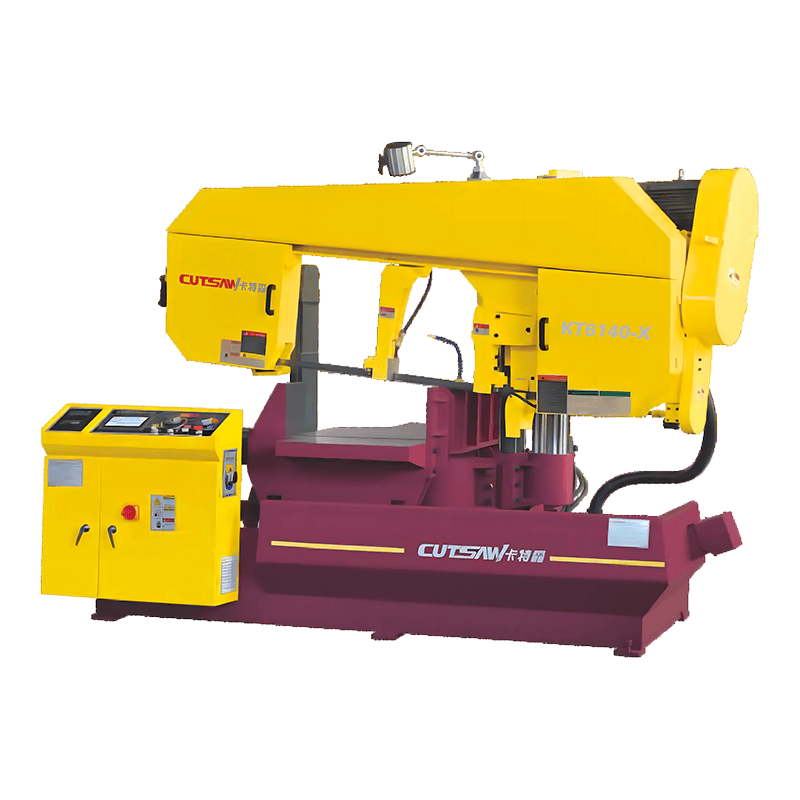 KT6140-X 45-Degree Metal Cutting Angle Band SawWith angle capability for miter cuts, this machine turns a single setup into a miter-cutting station, matching the supporting details outlined above. Adjustable cutting angles deliver precise bevels, making it a practical choice for shops cutting angles without a second machine.View Product →
Coolant System and Chip Removal
Band sawing is a heat-management process. The coolant system — pump, tank and nozzles — floods both sides of the blade, drawing heat from the teeth and flushing chips from the gullets so they are not re-cut. A wire brush at the drive wheel cleans the band on each revolution; larger automatic machines add a chip conveyor that clears swarf without stopping production.
Hydraulics and Controls: From Semi-Automatic to CNC
The hydraulic power unit is the machine's muscle: it lowers the head, clamps the vise and applies feed force. Basic models regulate feed with flow valves; constant-load control instead monitors cutting resistance and adjusts feed pressure in real time, protecting blade and finish when the cross-section changes mid-cut.
Above that sit the automation components. A semi-automatic machine cycles the cut but waits for the operator to load. A fully automatic CNC machine adds servo feed, a programmable controller and an HMI for cut length, quantity and nesting; models like the KT560NC below add variable-frequency wheel drive so blade speed and feed rate can be matched to each job.
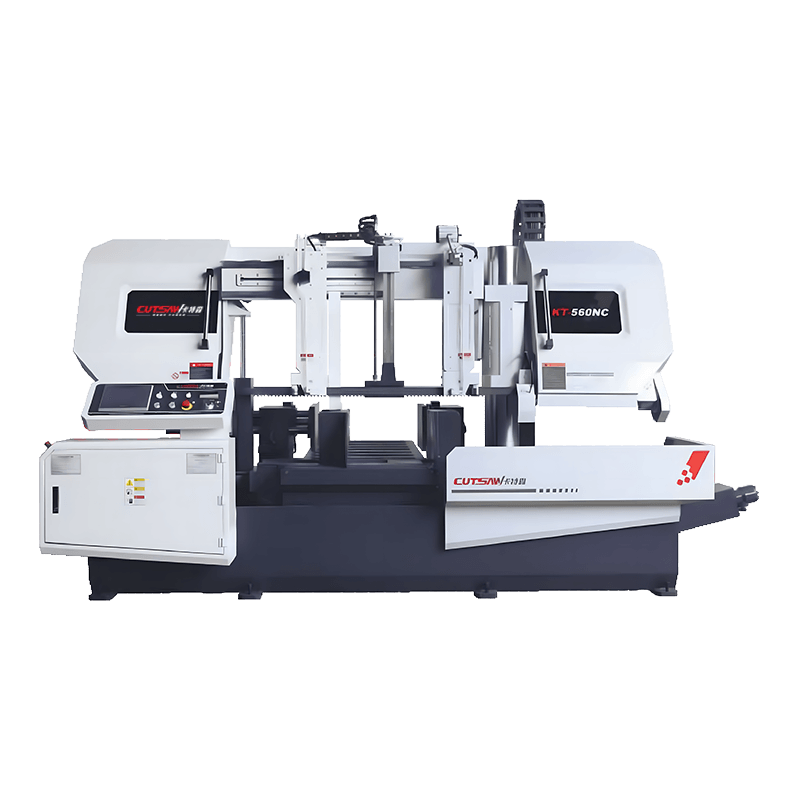 KT-560NC Fully Automatic CNC Horizontal Band SawAs a fully automatic model with servo feed, programmable control and variable-frequency wheel drive, this saw matches the automation components discussed above. It lets operators match blade speed and feed to each job while cutting cut length and quantity unattended.View Product →
Component Checklist: What to Verify Before You Buy
Use the component map as an inspection sequence. The table below condenses the eight groups and the checks that reveal their true condition on a demonstration floor.
| Component | What it does | What to check before buying |
|---|---|---|
| Bed and frame | Carries the vise and workpiece, absorbs vibration | Welded, stress-relieved construction; correct base levelling |
| Saw head and columns | Guides head travel, carries wheels and guides | Twin columns or rigid pivot; smooth, controlled descent |
| Drive and idler wheels | Form and drive the blade loop | Wheel size and alignment; stable blade tracking |
| Motor and gearbox | Deliver torque and blade speed | Speed range or VFD matched to your material mix |
| Blade guides and tension | Keep the blade beam upright | Carbide or roller guides; hydraulic tension control |
| Vise and material support | Clamp and index the workpiece | Hydraulic vise force; angle capability; support rollers |
| Coolant and chip handling | Control heat and evacuate swarf | Nozzle coverage on both blade runs; tank size; chip conveyor |
| Hydraulics and CNC | Govern feed force and automation | Constant-load control; servo feed; HMI functions |
Matching the Components to Your Cutting List
Component knowledge turns a catalogue into a decision. Cutting large solid bars all day? Column rigidity and constant-load feed dominate. Bundle-cutting small tube? Automatic feed and bundle clamping matter more than peak power. Angular joints for frames? A rotating vise removes an entire second setup. Plate, beam and long structural work point toward vertical layouts.
We build every one of these layouts in-house as a CNC band saw machine manufacturer based in Zhejiang, China — producing since 2000, with an annual capacity of 3,600 machines and ISO 9001 and CE certification behind every shipment. Tell us your material, section size and daily volume, and we will map each component choice to your cutting list rather than to a specification race.
Walk every candidate machine in the same order: frame, head, wheels, drive, guides, tension, vise, coolant, controls. Ask the supplier to demonstrate each component under real load, not on idle, and to explain why each part is sized the way it is. The machine that answers cleanly is the one that will still be cutting square years from now.