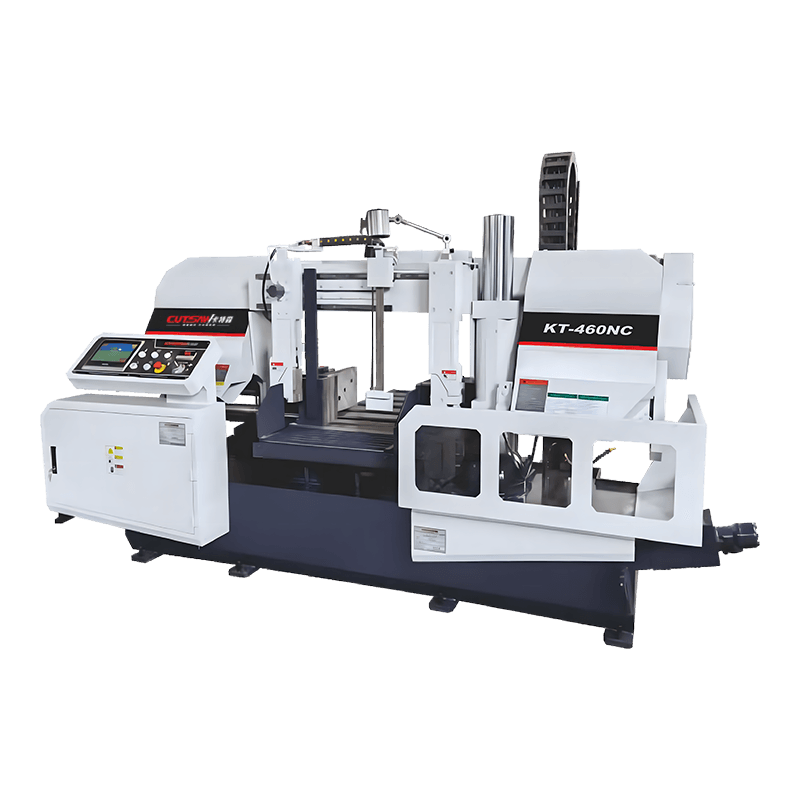
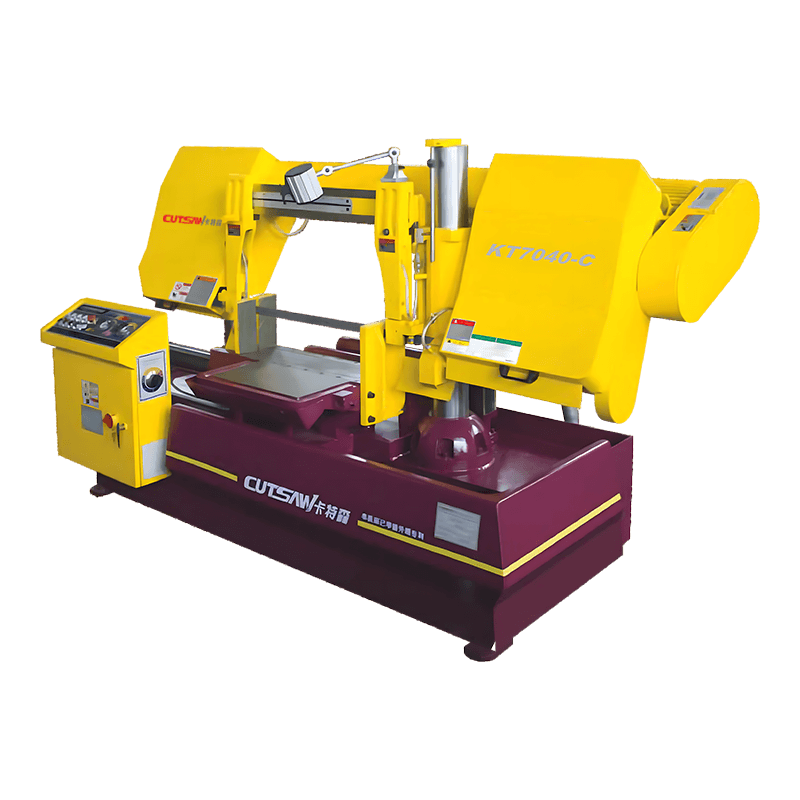
English
 русский
 简体中文
简体中文


Blade drift on a vertical band sawing machine is the tendency of the blade to cut at an angle rather than straight along the intended line. Drift compensation works by adjusting the fence angle to match the blade's natural cutting path — not by forcing the blade to cut perpendicular to the table. And yes, wet lumber produces significantly more drift than dry lumber, due to greater resistance, fiber inconsistency, and increased friction across the blade body.
What Causes Blade Drift on a Vertical Band Sawing Machine
Drift is not a defect in the machine itself — it is a natural result of several interacting variables. Understanding these causes is the first step to effective compensation.
- Uneven blade set: Band saw blades have teeth that are set alternately left and right. If one side is set more aggressively than the other, the blade pulls in that direction.
- Blade tension imbalance: Insufficient or uneven tension causes the blade to flex laterally under load, especially when cutting dense or wet material.
- Guide misalignment: Blade guides that are not properly positioned allow lateral movement during the cut.
- Feed rate and material resistance: Pushing material too fast increases lateral pressure on the blade, amplifying drift.
- Blade width and TPI: Narrow blades (e.g., 1/4 inch) drift more easily than wider blades (e.g., 3/4 inch or 1 inch) under equivalent load.
On a vertical band sawing machine, drift angles typically range from 1° to 5° depending on blade condition and material type. In severe cases with worn blades or wet wood, drift can exceed 7°, making straight cuts nearly impossible without compensation.
How Blade Drift Compensation Works
The principle behind drift compensation on a vertical band sawing machine is straightforward: rather than correcting the blade's path, you align the rip fence to follow the blade's natural direction.
Step-by-Step Drift Angle Calibration
- Draw a straight line on a scrap piece of the same material you plan to cut.
- Freehand-feed the workpiece along that line using only your hands — no fence — at a comfortable, consistent pace.
- When the blade reaches mid-board, stop the machine with the blade still in the cut.
- Hold the board firmly in place and use a bevel gauge or digital angle finder to measure the angle between the board's edge and the miter slot.
- Set the rip fence to this exact angle. On most vertical band sawing machines with an adjustable fence, this is done by loosening the fence pivot bolt and rotating the fence body.
- Lock the fence and verify with a test cut before proceeding to production work.
Some modern vertical band sawing machines include a micro-adjustable fence with a built-in drift scale, allowing operators to dial in compensation without freehand testing. Machines equipped with digital readout (DRO) systems can store drift offset values per blade profile.
Importantly, drift compensation must be re-calibrated every time the blade is changed, since each blade has a unique tooth geometry and set pattern. Using the same fence setting across different blades is one of the most common errors on the shop floor.
Wet Lumber vs. Dry Lumber: How Material Moisture Affects Drift
Moisture content (MC) in lumber has a direct and measurable impact on blade drift behavior on a vertical band sawing machine. Wet lumber — typically defined as having an MC above 19% — presents fundamentally different cutting conditions compared to kiln-dried lumber at 6–12% MC.
| Factor | Wet Lumber (>19% MC) | Dry Lumber (6–12% MC) |
|---|---|---|
| Blade friction | High (resin + moisture) | Low to moderate |
| Fiber consistency | Irregular, soft pockets | Uniform and predictable |
| Lateral blade pressure | High | Low to moderate |
| Typical drift angle | 3°–7° or more | 1°–3° |
| Blade wear rate | Accelerated | Normal |
| Sawdust/chip clearance | Poor (wet chips clog gullets) | Good |
| Recommended blade type | Wide, low TPI (2–3 TPI), hook tooth | Medium width, 3–6 TPI, regular or skip tooth |
When cutting green or freshly milled lumber on a vertical band sawing machine, the high moisture content causes the kerf to partially close behind the blade due to wood fiber spring-back. This closing pressure pushes laterally on the blade body, substantially increasing drift and risking blade pinching or breakage. Using a riving knife or kerf splitter behind the blade is strongly recommended in these conditions.
Blade Selection to Minimize Drift by Material
Choosing the correct blade for each material is the most effective way to reduce drift before compensation is even needed. On a vertical band sawing machine, the following guidelines apply:
- Wet/green lumber: Use a wide blade (3/4 inch or 1 inch) with 2–3 TPI and a hook tooth profile. The large gullets clear wet chips efficiently, reducing lateral loading.
- Dry hardwood: A 1/2 inch to 3/4 inch blade with 3–4 TPI and regular tooth form provides good balance between drift resistance and surface finish.
- Kiln-dried softwood: A 1/4 inch to 1/2 inch blade with 4–6 TPI is sufficient. Drift is minimal, and narrower blades allow tighter curves if needed.
- MDF and particleboard: These materials are highly abrasive. Use a carbide-tipped blade on the vertical band sawing machine with 4–6 TPI to maintain consistent tooth geometry and minimize progressive drift caused by blade dulling.
Mechanical Adjustments That Support Drift Compensation
Drift compensation through fence angle adjustment works best when the vertical band sawing machine itself is properly tuned. The following mechanical checks should be performed regularly:
Blade Tension
Most vertical band sawing machine manufacturers specify blade tension in terms of deflection: the blade should deflect no more than 1/4 inch (6mm) under 1 lb (0.45 kg) of side pressure at the midpoint between guides. Under-tensioned blades are the single largest contributor to unpredictable drift.
Guide Bearing Alignment
Both upper and lower blade guides should be positioned within 1/64 inch (0.4mm) of the blade body without touching during idle running. Guides that are too far from the blade allow excessive lateral movement; guides that are too close create friction heat and accelerate blade fatigue.
Wheel Coplanarity
If the upper and lower drive wheels of the vertical band sawing machine are not in the same plane, the blade will track off-center and introduce a systematic drift that cannot be fully corrected by fence adjustment alone. Wheel alignment should be verified with a straightedge whenever drift is unusually severe or appears immediately after blade installation.
- Always calibrate drift compensation with the actual material and blade you will be using in production — not a substitute.
- When switching from dry to wet lumber mid-session, re-test and re-adjust the fence angle — do not assume the same compensation applies.
- Mark your fence with a dedicated drift scale or witness marks for common material/blade combinations to speed up future setups.
- Reduce feed rate by approximately 20–30% when transitioning from dry to wet lumber to allow the blade more time to clear chips and maintain a straight path.
- Inspect blade teeth after every 2–4 hours of cutting wet lumber. Dull or unevenly worn teeth are the fastest path to uncontrollable drift on a vertical band sawing machine.