English
 русский
 简体中文
简体中文


The chip removal system on a CNC Sawing Machine is fundamentally more automated, integrated, and process-aware than that of a circular sawing machine. While both machines generate metal chips during cutting, the way each handles those chips differs significantly in design philosophy, conveying method, coolant integration, and overall impact on production efficiency. Understanding these differences helps manufacturers choose the right machine for high-volume or precision cutting environments.
How Chip Generation Differs Between the Two Machines
The nature of chip generation is shaped by the cutting method itself. A CNC Sawing Machine — typically a band saw or hack saw type — uses a continuous or reciprocating blade that moves at relatively low speeds (typically 20–100 m/min for band saws). This produces long, curling chips or fine swarf depending on the material.
A circular sawing machine, on the other hand, uses a rotating toothed disc spinning at speeds up to 300–5,000 RPM. This generates short, fragmented chips that are ejected radially at high velocity. The difference in chip morphology directly determines which removal system is appropriate.
- CNC Sawing Machine chips: longer, ribbon-like, tend to accumulate near the blade guide
- Circular sawing machine chips: short, fragmented, ejected in all directions around the blade
- Chip volume per cut is typically higher in circular saws due to larger kerf widths (up to 4–6 mm vs. 1.3–2 mm on band-type CNC saws)
Chip Conveying Systems: CNC Sawing Machine vs Circular Sawing Machine
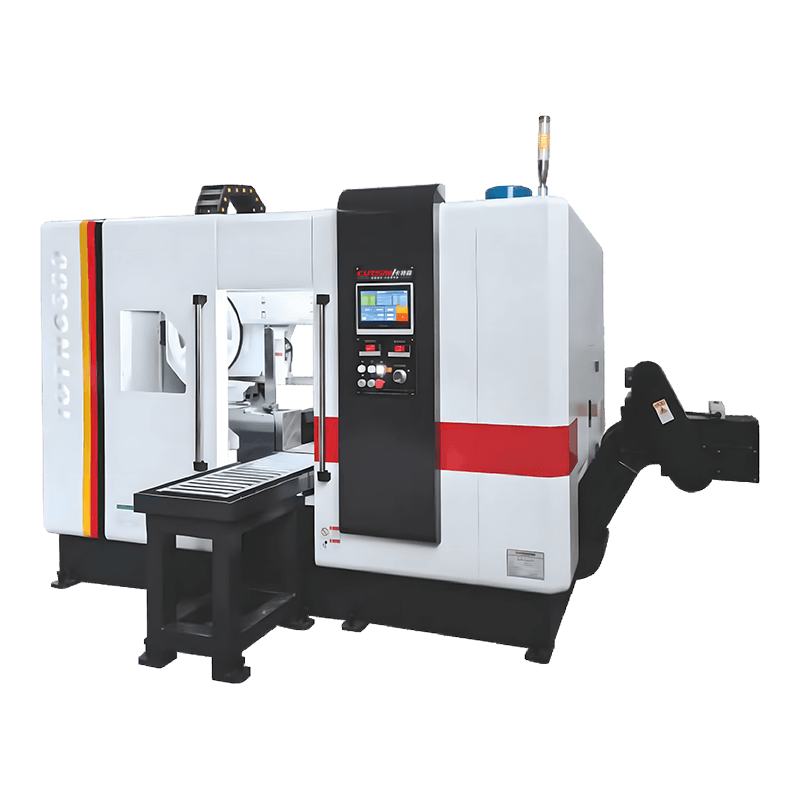
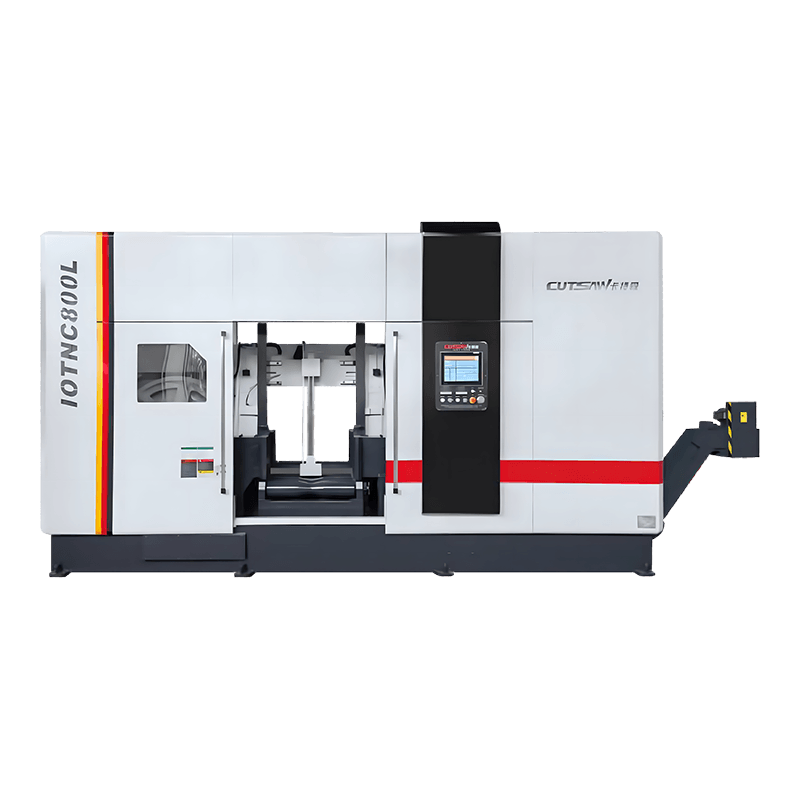
Modern CNC Sawing Machines are commonly equipped with integrated chip conveyor systems — either hinged belt conveyors, scraper conveyors, or magnetic conveyors — that automatically transport chips away from the cutting zone to a collection bin. This automation is essential for unattended or lights-out production runs.
Circular sawing machines more often rely on chip trays, splash guards, and manual or semi-automatic chip pans. While some industrial circular saws include basic auger conveyors, the high-speed ejection of chips makes full containment more challenging and often requires more frequent manual intervention.
| Feature | CNC Sawing Machine | Circular Sawing Machine |
|---|---|---|
| Chip conveyor type | Belt / scraper / magnetic conveyor | Chip tray / basic auger |
| Automation level | Fully automatic in most models | Semi-automatic or manual |
| Chip ejection direction | Controlled, downward / lateral | Radial, high-velocity scatter |
| Operator intervention needed | Low (cycle-based auto removal) | Medium to high |
| Integration with coolant system | Tightly integrated (chip + coolant loop) | Separate or minimal |
Coolant Integration and Chip Flushing
One of the clearest advantages of the CNC Sawing Machine's chip removal design is its tight integration between the coolant system and chip evacuation. Most CNC band sawing machines use flood coolant directed precisely at the blade-material contact point. This coolant serves a dual purpose: it lubricates the blade and simultaneously flushes chips away from the cutting zone into a chip collection sump.
The coolant then passes through a filtration unit — often a drum filter or paper-band filter — where chips are separated and collected before the coolant is recirculated. In high-end CNC Sawing Machines, chip briquetting systems can compress collected swarf by up to 80%, reducing disposal volume significantly.
Circular sawing machines, especially cold circular saws, often use minimal or no coolant (relying on dry cutting or light mist lubrication). This means chip flushing is largely absent — chips must be mechanically removed or blown away with compressed air. This limits chip management efficiency and increases the risk of chip re-cutting, which can damage the blade surface.
Impact on Cutting Zone Cleanliness and Part Quality
Chip accumulation in the cutting zone is a direct cause of blade wear, surface finish degradation, and dimensional inaccuracy. Because the CNC Sawing Machine manages chip removal continuously and automatically, the cutting zone remains cleaner throughout the cycle. This contributes to more consistent cut surface finishes — typically achieving Ra 3.2–6.3 µm without secondary finishing.
On circular sawing machines, scattered chips can re-enter the cutting path — especially in high-speed operations — resulting in micro-scratches or burr formation on cut faces. In bundle cutting scenarios, chip buildup between workpieces can cause vibration and affect squareness of cut.
Key quality-related effects of chip removal efficiency:
- Poor chip removal → increased blade tooth loading → accelerated wear
- Chips caught between workpiece and blade → surface scratching or burring
- CNC Sawing Machine's continuous flush system reduces re-cutting probability to near zero
- Circular saw's dry-cut chip scatter may require post-cut deburring steps
Maintenance Implications of Each Chip Removal Design
The chip removal system directly affects how often and how deeply each machine requires maintenance. A CNC Sawing Machine's integrated conveyor and coolant filtration system requires scheduled filter replacements (typically every 200–400 operating hours for paper-band filters) and conveyor belt inspections. However, this planned maintenance prevents unexpected downtime caused by chip clogging.
Circular sawing machines with manual chip trays demand more frequent operator attention during production — particularly in high-volume environments. If chips are not cleared regularly, they can pack into the blade guard housing, increasing the risk of blade deflection or motor overload. In some production settings, this can add 15–30 minutes of manual cleaning time per shift.
Maintenance frequency comparison:
- CNC Sawing Machine: Conveyor inspection weekly; coolant filter change every 200–400 hrs; sump cleaning monthly
- Circular sawing machine: Chip tray clearance every few hours during production; blade guard cleaning daily; no coolant filtration loop in most models
For production environments where large volumes of metal are cut continuously — such as steel service centers, aluminum extrusion shops, or structural fabrication facilities — the CNC Sawing Machine offers a clear advantage in chip management. Its automated conveyor system, closed-loop coolant filtration, and minimal operator intervention make it suitable for unattended or automated line integration.
The circular sawing machine, while faster per cut in many applications and excellent for short-cycle, high-throughput jobs, is better suited to environments where cut volumes are moderate, materials are dry-cuttable, and chip accumulation can be managed with simple housekeeping routines.
Ultimately, the choice between these two machines should factor in not just cutting speed or material compatibility, but also how chip generation and removal will affect total production uptime, part cleanliness, and maintenance labor costs over the machine's operational lifespan.