English
 русский
 简体中文


A shop foreman calls about a band saw that stalls halfway through 250 mm stainless bar. The blade is new, the coolant is clean and the tension is set to the manual. The sawing machine motor starts the cut at roughly half its rated current and sits at full load three minutes later. The fix is not a different blade. The machine was specified for carbon steel and is now being asked to cut a work-hardening alloy that demands a different combination of blade speed, feed force and available torque.
Motors on sawing machines are really specified by three numbers: rated power, torque at the blade speed you actually cut at, and the way that speed is controlled. Get those three right and the machine holds the tolerance you quoted. Get them wrong and you will spend the life of the machine buying blades, re-cutting parts and explaining why squareness drifts across a shift.
Why the Motor, Not the Blade, Sets the Ceiling on Every Cut
A saw motor rarely fails because a cut is difficult. It fails because the machine was asked to hold a cutting rate it was never sized for. Blade torque comes from motor torque multiplied by the gear ratio and drive efficiency, so when load exceeds what the motor can deliver, band speed falls. A slower blade at the same feed force takes a thinner chip, the tooth rubs instead of cutting, and the material work-hardens under the tooth tip.
- Blade speed drops under load, so the saw deflects and cuts out of square.
- Chips get thin and hot, dulling teeth long before the blade reaches its rated life.
- Cycle times stretch, and the cost shows up in labour and downtime rather than on the electricity bill.
- The motor runs hot, insulation ages faster and the drive trips on overload more often.
A motor that holds its speed through the whole cut is worth more than a motor with a bigger nameplate. Torque at cutting speed is the number that matters.
This is why two machines with the same nameplate power can behave like different classes of equipment. A low-speed band saw cutting a large solid section needs torque at 25 to 40 m/min. A machine cutting thin-wall tube at 80 m/min needs speed and control more than raw torque. The duty point, not the kilowatt figure, decides the outcome.
Drive Configurations You Will Meet on a Sawing Machine
Almost every metal saw on the market uses one of four drive arrangements. Each has a different torque curve, a different cost of ownership and a different set of jobs it should never be given.
| Drive configuration | Typical role | Best suited work | Trade-offs |
|---|---|---|---|
| Fixed-speed AC induction motor with gear reducer | One blade speed, direct on-line starting | Small bar, tube and light profiles in one material family | No speed adaptation; bogs down in hard alloys and large sections |
| AC induction motor with variable frequency drive | Blade speed changed to match the material | Mixed production, thick sections, stainless and alloy steel | Needs correct drive parameters and an inverter-duty motor |
| Servo-driven blade and feed axes | Closed-loop control of speed and feed rate | High-volume automated cutting to tight length and squareness tolerance | Higher purchase price and a higher technical skill floor |
| High-speed spindle motor on a circular saw | Carbide blade turning at high rpm | Plate, thin-wall tube, aluminium and non-ferrous stock | Requires rigid clamping and the right blade grade |
The pattern is simple: the more control you need over blade speed and feed, the further the drive moves from a fixed-speed induction motor toward a VFD or servo system. That progression is not marketing language. It is the only practical way to hold cutting conditions across a mixed material list without changing pulleys or gear ratios.
Matching Motor Power and Blade Speed to the Material
Three inputs decide how much motor a job needs: the largest cross-section you will actually cut, the tensile strength and work-hardening behaviour of the material, and how many hours a day the machine really cuts.
- Measure the biggest section you expect in the next two years, not the average of last month's work.
- Group your materials. Stainless and high-alloy steels need lower blade speed and more torque headroom than mild steel at the same diameter.
- Size with 20 to 30 percent headroom for continuous cutting; short-run or intermittent work can run closer to the limit.
- Check torque at the lowest blade speed you will use. A motor that cannot hold 25 m/min under load is not the machine its nameplate suggests.
- Confirm the duty cycle and the shop environment. Three shifts in a hot bay is a different load case from one shift in a ventilated cell.
On servo-driven machines, blade drive and feed work in a closed loop, so the controller can slow the blade and reduce feed together instead of letting the cut stall. In our own catalogue, the KT660NC is listed as a high-speed servo band saw built this way, with the drive holding cutting conditions rather than reacting to them after the blade has already slowed.
What a Variable Frequency Drive Actually Changes
A variable frequency drive does more than let an operator dial blade speed up and down. It changes how the machine behaves at the start of a cut, in the middle of a hard inclusion, and at the end of a long shift.
- Soft starting reduces the shock load that travels through the blade, gearbox and workpiece clamp.
- Speed recipes per material let the operator call up the right band speed for stainless, mild steel or aluminium instead of compromising on one setting.
- Torque limiting protects both blade and drive when the cut runs into a hard spot.
- Energy use tracks the work, because the motor is not held at full speed when the cut does not need it.
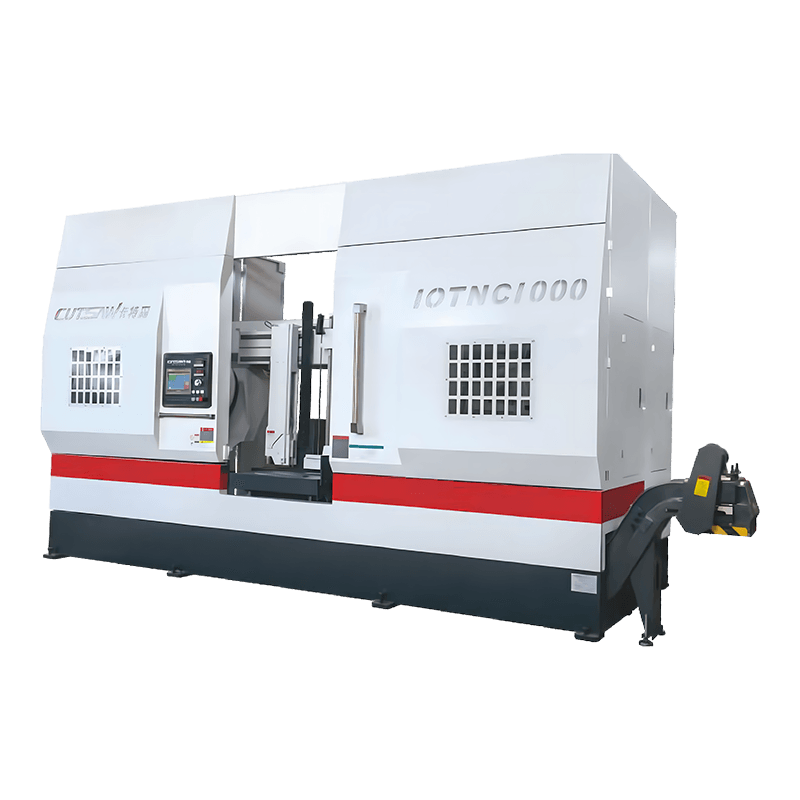
Machines that combine variable frequency control with automatic feed, such as the IoTNC650 in our smart high-speed range, hold a cutting recipe across a batch rather than relying on the operator's ear. That consistency is where the tolerance on a drawing actually comes from, and it is the same control loop that keeps squareness steady from the first part to the hundredth.
If you want the engineering detail behind that loop, our note on CNC band sawing machines and precision cutting walks through how speed, feed and clamping interact on a modern saw.
When a Circular Saw Motor Is the Better Answer
A circular saw uses a different motor duty: a high-speed spindle turning a carbide-tipped blade at hundreds or thousands of revolutions per minute. That suits plate, thin-wall tube and non-ferrous stock, where cut finish and cycle time matter more than section capacity. Band saws still win on large solid sections and mixed batches, where kerf loss and blade cost per cut drive the arithmetic. One practical warning: check the clamping system with the same attention you give the spindle motor, because the wrong vise chips blades on the first bundle. The KY230 in our high-speed circular saw range is built around that spindle-motor approach, for production cutting where blade change time has to stay short.
Warning Signs That the Motor Is Failing or Wrongly Applied
Most motor problems on a saw announce themselves weeks before the machine stops. This list separates wear from misapplication.
- The motor housing runs noticeably hotter than the gearbox after an ordinary cut.
- The breaker trips at start-up or during heavy sections rather than under light load.
- Blade speed audibly drops as the blade enters the material and recovers as it exits.
- Cut faces show burnishing, discolouration or a work-hardened skin.
- The load meter sits near maximum for the whole cut instead of rising and settling.
- Blade consumption climbs without any change in material or blade supplier.
What to Confirm Before You Buy or Replace a Saw Motor
Whether you are specifying a new saw or ordering a replacement motor, these checks prevent the two most expensive mistakes: a motor that does not match the local power supply, and a drive that cannot deliver torque at the low blade speed the job needs.
- Voltage, phase and frequency at the machine position. A 380 V / 50 Hz winding will not perform correctly on a 480 V / 60 Hz supply.
- Rated power together with the blade speed it is rated at, so the two figures are read as one specification.
- Duty cycle, insulation class and enclosure rating, especially where coolant mist and swarf are constant.
- Gearbox ratio and the resulting blade speed range, verified at the low-speed end where torque is hardest to hold.
- Inverter-duty rating if a drive is fitted or planned.
- Certification and documentation, including CE marking for export markets and traceable quality records.
- Spare motor, drive and gearbox availability, plus the response time for drive parameter support.
It also helps to see how different drive configurations sit across a full product family before choosing. The band saw and circular saw range we build covers fixed-speed, variable frequency and servo-driven machines, which makes the trade-offs easier to compare side by side.
Getting the Motor Decision Right the First Time
The sawing machine motor is where material, blade and tolerance meet. Rated power alone tells you very little; what matters is torque at the blade speed your material needs, and the control system that keeps that speed steady from the first millimetre of the cut to the last. A machine sized for the largest section on your material list will cut faster, use fewer blades and hold the tolerance you quoted.
Before the next specification lands on your desk, answer three questions: what is the largest section, what is the hardest material, and how many hours a day will the saw run? Those three answers decide whether a fixed-speed motor, a variable frequency drive or a servo system is the honest choice. Everything else, including the blade, follows from that.