English
 русский
 简体中文


Sawing machine mechanism — a practical field guide
Four Mechanisms, One Straight Cut
Blade drive, tension, down-feed, and structure: how each one shapes the accuracy of a metal cut, and how to spot the weak link before it costs you a workpiece.
On the end face of a freshly cut 200 mm round bar, the state of a sawing machine mechanism is impossible to hide. A clean square face with even tooth marks means the blade drive, tension system, down-feed, and machine structure are working in agreement. A drifting kerf, a bowed cut, or burnished saw marks means one system has already failed — usually before the operator notices.
Every metal-cutting band saw, from a compact hydraulic semi-automatic to a gantry CNC machine, follows the same chain: the blade is driven in a loop, held in tension, guided close to the work, and pressed into the material at a controlled rate while coolant and chip removal handle the aftermath. A weak link in that chain changes the geometry of every part that follows.
Four Systems Inside Every Sawing Machine Mechanism
A sawing machine is easier to read in four mechanical groups than as one large assembly.
- Blade drive — motor, reduction gearbox, drive wheel, and idler wheel that keep the blade loop moving at the chosen surface speed.
- Tension and guides — the parts that stretch the blade and hold its path straight from the wheels to the cutting zone.
- Feed mechanism — hydraulic cylinder, servo axis, or gravity weight that presses the blade into the work and controls penetration speed.
- Control and auxiliary systems — vice hydraulics, coolant, chip transport, and on CNC models the servo drives and sensors that sequence the cycle.
Most cutting faults — snaking cuts, premature blade breakage, rough surfaces, drifting lengths — belong to one of these groups. Naming the group correctly is half the diagnosis.
The Blade Drive: A Closed Loop of Torque and Speed
The blade drive decides what the rest of the mechanism can do. The blade is a closed steel loop pulled around two wheels; the drive wheel transmits torque while tension locks the loop to the wheel surface. Cutting torque is what stops the teeth from stalling when the blade enters a wide cross-section. If the blade stops under load and the wheels keep turning, the teeth rub, temperature climbs, and the cutting edge deteriorates quickly.
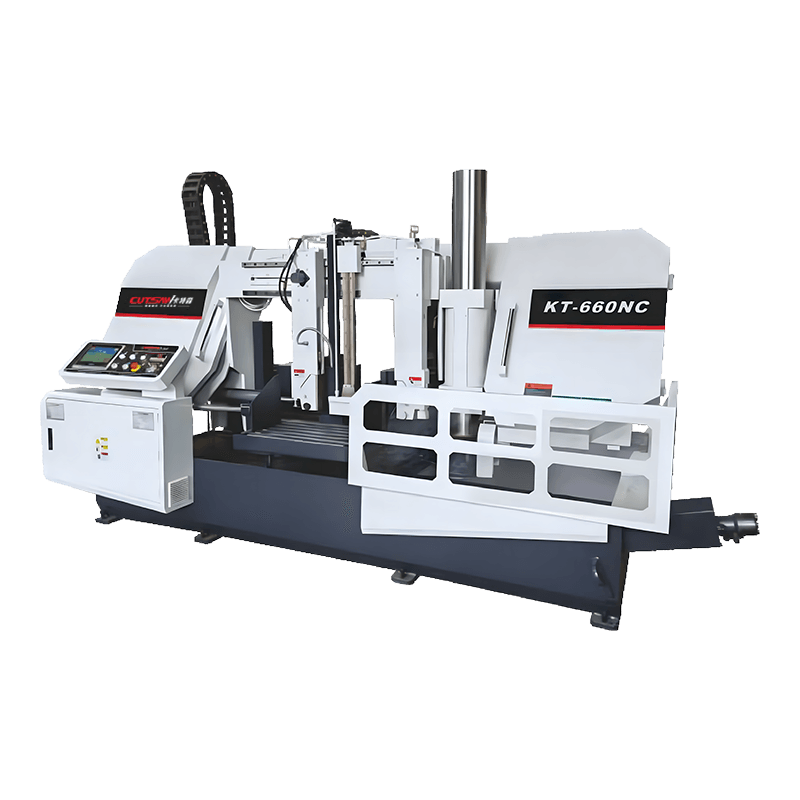
A variable-frequency or servo drive holds a stable surface speed as the load changes. That is why high-capacity models like the KT660NC servo band saw keep tooth loading and heat predictable in production; constant blade speed protects edge life, not operator comfort.
Blade Tension and Guides: Where Straightness Is Decided
Too little tension and the cut wanders; too much and the blade breaks early. The tension mechanism — a hand-wheel, spring pack, or hydraulic cylinder — keeps the blade stiff enough to resist lateral pressure while still flexing around the wheels. A reliable tension indicator removes most guesswork.
Guides finish the straight-line job. Two arms carry carbide pads that pinch the blade on both sides near the workpiece; the blade is never straighter than in the short span between those pads and the cut. Worn guides, a wide gap, or an arm left too far from the work lets the blade flex laterally and bow the cut, even when tension and frame are perfect.
The blade can only cut as straight as the mechanism that holds it steady.Workshop rule
Down-Feed and Constant-Load Mechanisms: Letting the Blade Work at Its Own Pace
The feed mechanism controls how fast the blade is pressed into the metal, and modern saws avoid fixed feed rates for one reason: the cross-section changes as the cut advances. Cutting a hollow profile means the blade enters full material, crosses an open interior, then hits the far wall. A fixed rate overloads the teeth at entry and exit; a constant cutting force lets the blade advance exactly as fast as it can remove material.
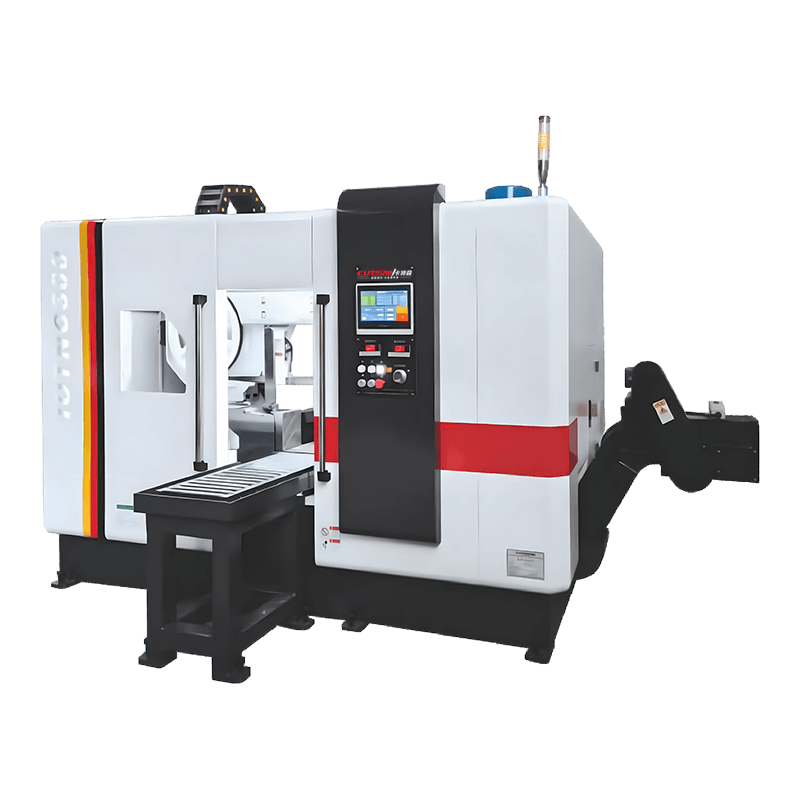
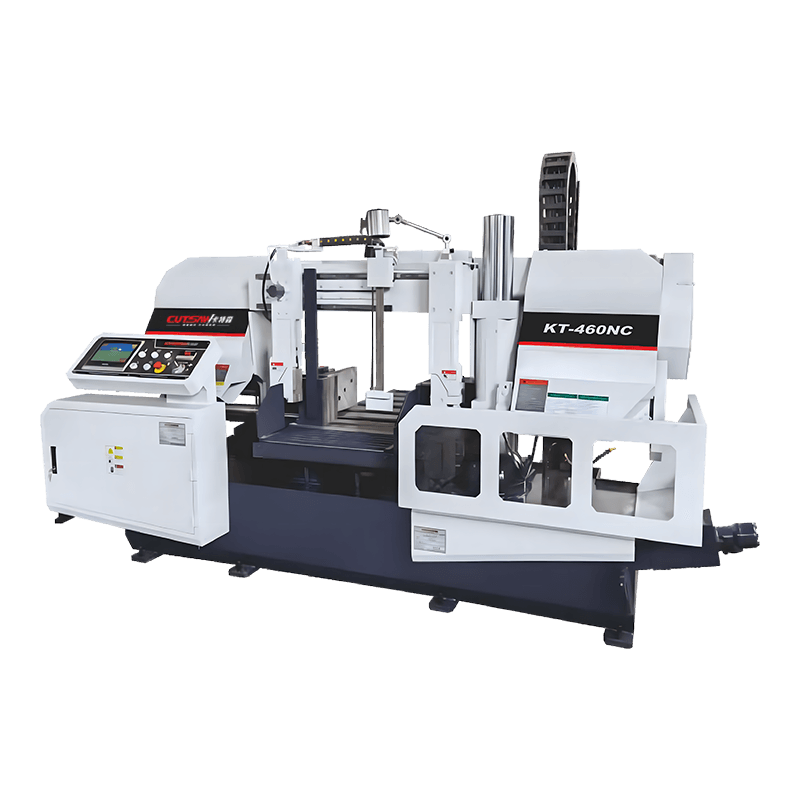
Constant-load control is the defining mechanism of our constant-load CNC band saw series. Instead of commanding a fixed descent speed, the hydraulic circuit maintains a stable cutting force and lets the blade speed adjust to the width of material being removed. That single difference makes structural and intermittent cuts far more stable.
| Feed mechanism | How it behaves | Best suited to | Main risk |
|---|---|---|---|
| Gravity | A weight pushes the bow; no regulation | Light, intermittent workshop use | Unstable on varying cross-sections |
| Hydraulic feed-rate | A needle valve restricts oil flow; descent speed is fixed | Regular solid bars | Speed drifts with oil temperature |
| Constant-load | Pressure controls cutting force; speed varies naturally | Tubes, profiles, and bundle cutting | Requires clean hydraulic oil |
| Servo / CNC | A position-controlled axis; speed set by program or sensors | Batch automation and high-volume cutting | Needs trained setup |
 Constant-Load CNC Band Saw Machines for Stable Structural CutsExplore the CUTSAW constant-load series, where hydraulic control maintains steady cutting force, reducing vibration and extending blade life on intermittent and tube-wall cuts.View Product →
In practice, constant-load control shows up first when the part is not a solid round bar: stable tooth load through a tube wall means flatter faces and longer blade life.
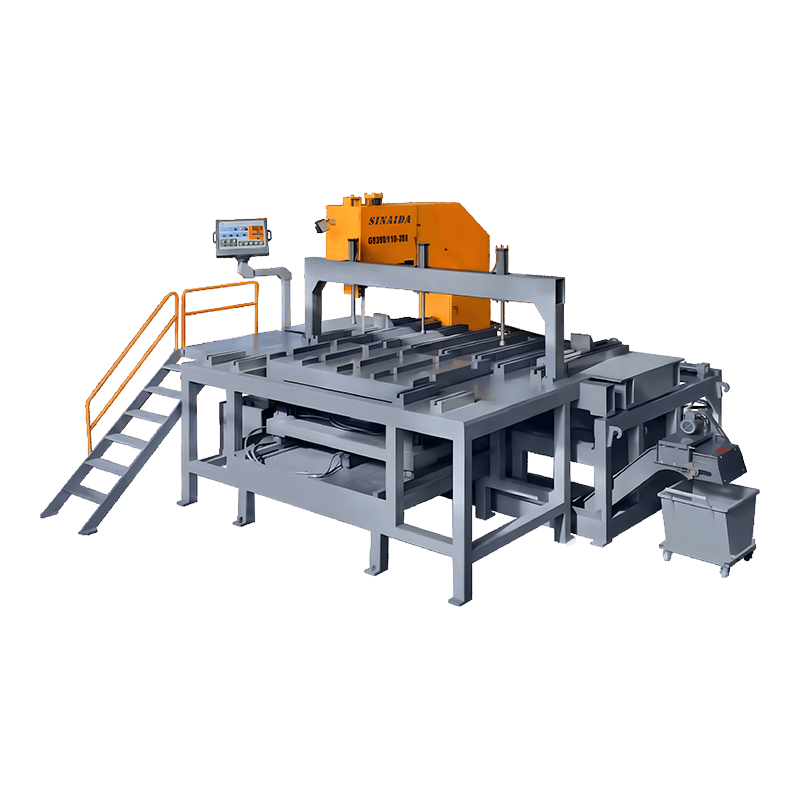
Double-Column and Gantry Structures: The Passive Mechanism of Squareness
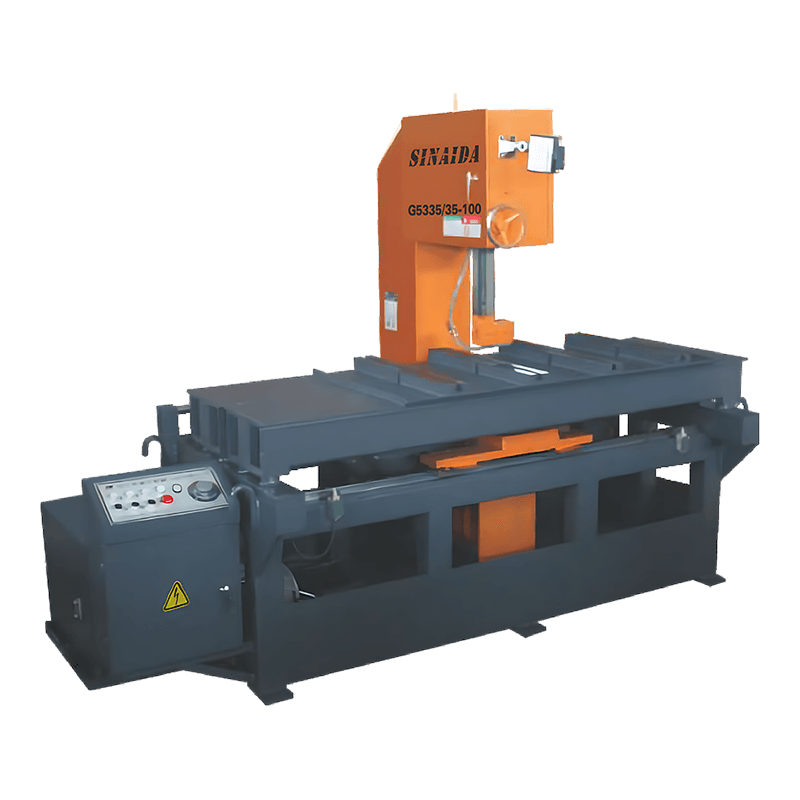
The frame is part of the mechanism even though it does not move. The bow must descend without tilting; if the head pivots a fraction of a degree under load, the part leaves the vice out of square. Single-column designs are economical, but a double-column structure guides the bow on two parallel posts and holds the blade's attitude through the full stroke.
Gantry designs extend the same logic to large work — billets, die blocks, and structural sections — where one failed cut is expensive. Evaluate the vice together with the frame: a rigid machine with a weak clamp still produces drift because the part moves under load.
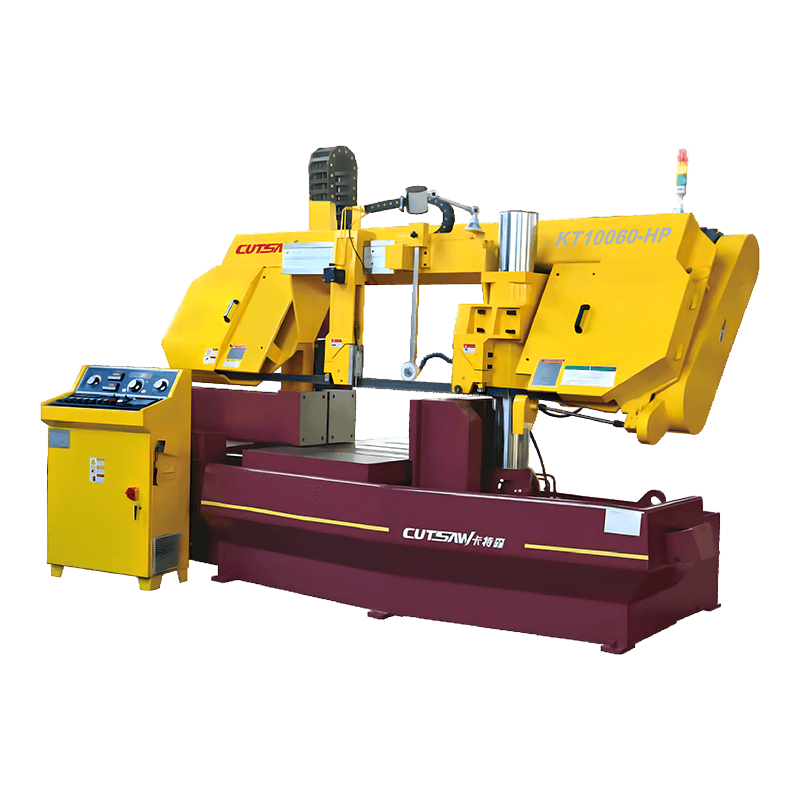 Double Column Band Saws for Heavy-Duty WorkpiecesReview the double column models for large billets and die blocks, emphasizing rigid frames and reliable clamping to prevent drift under demanding, high-cost operations.View Product →
Angle and Rotary Mechanisms: Cutting at a Controlled Angle, Not by Eye
Miter cutting adds a complication the normal down-feed never faces: the blade meets the work with a sideways force, and whatever holds the angle becomes part of the mechanism. Simple machines swivel the head on a degree scale; CNC rotary models use a servo-driven table to index the workpiece while the blade stays fixed.
Two details matter more than the scale. The locking mechanism must clamp the rotating assembly positively under load — a head that shifts 0.2 degrees during the cut fails in the inspection gauge. And the rotary axis needs rigidity across the full workpiece width, not just at the pivot.
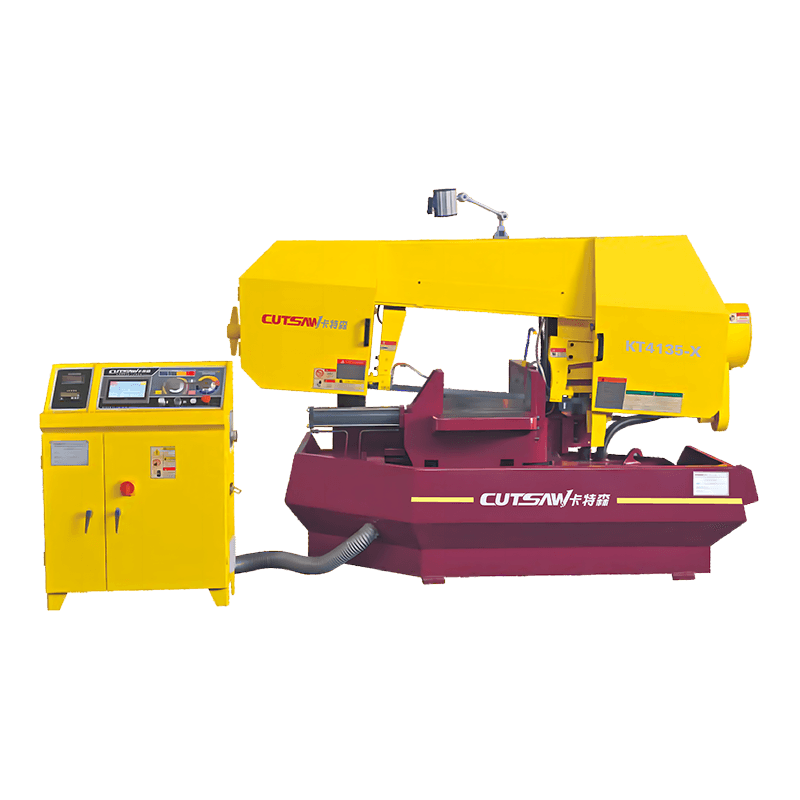 Angle Band Saw Machines for Precise Miter CuttingCheck the angle-cutting CUTSAW models with CNC swivel heads for accurate miter cuts down to 30°, designed for ferrous and non-ferrous materials with repeatable indexing.View Product →
CNC and Automation Mechanisms: Making the Cut Repeatable
Repeatability is not achieved by the program; it is achieved by the mechanism underneath it. A CNC saw adds a servo feed carriage, encoders, and automatic clamping that place the bar at a programmed length, but those electronics can only execute what the mechanical system permits. If the vice clamps differently each cycle or the carriage has backlash, the program repeats the same mistake with precision.
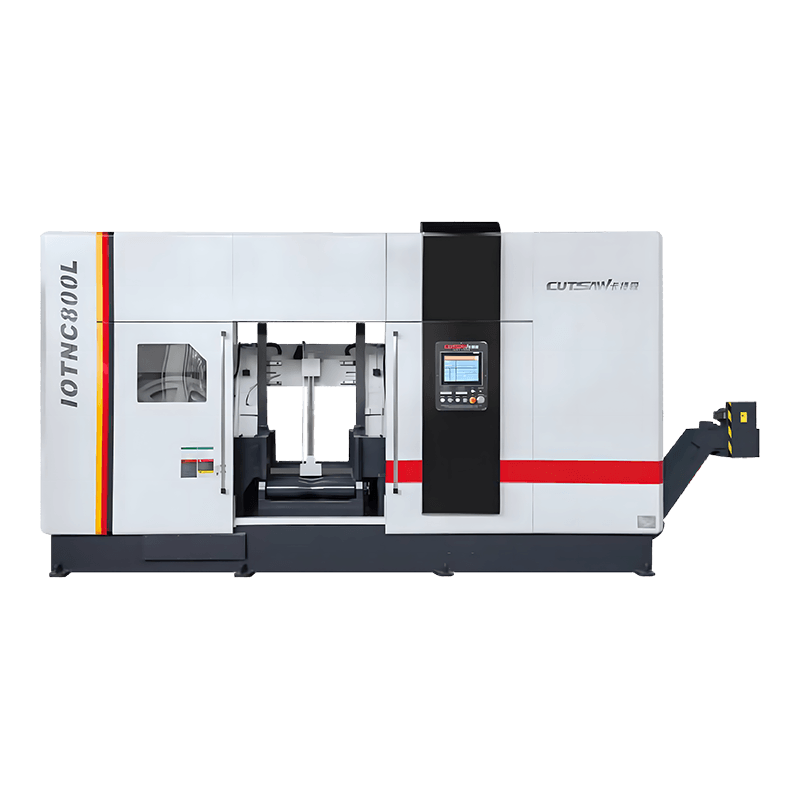
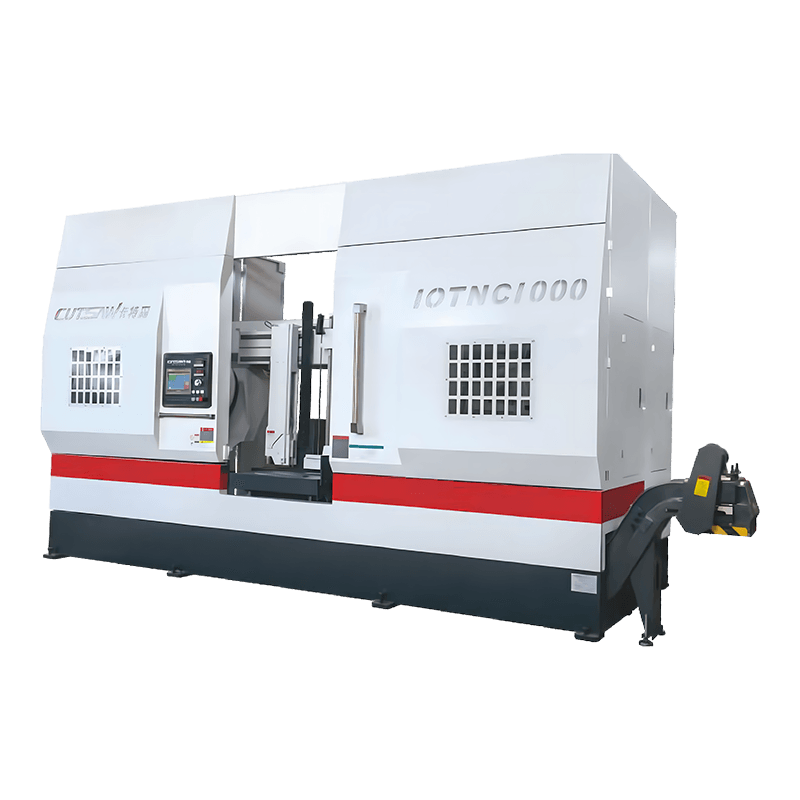
Machines like our smart high-speed IoTNC series connect the feed axis to the blade's actual performance; the control reads the load and adjusts the next pass. That is the level of integration to study when you evaluate the mechanism behind repeatable cut lengths — a clean mechanical layout will outperform a more powerful controller on a loose frame.
What to Inspect Before You Buy
The quickest view into a saw's mechanism is the machine running with the guards open. These checks correspond to the mechanisms that will decide whether cut quality survives the first thousand cycles.
Tension and tracking hold steady
Run the blade at full speed and watch the tracking. A blade that wanders on the wheels, or a tension gauge that creeps, points to worn adjustment parts or wheel misalignment.
Coolant and chip removal
Confirm the coolant lines flood both sides of the cut and the chip conveyor clears the discharge zone. Chips that stay in the kerf get re-cut by the blade and create the scratches you might blame on the blade.
Guides are a consumable part
Carbide guides wear no matter how carefully they are set. Ask about the guide design, replacement lead time, and ease of adjustment once the machine is on your floor.
Vibration reveals everything
Run the highest blade speed without a workpiece. A frame that trembles while cutting air will chatter under load, and no blade tension setting can fix vibration coming from the structure itself.
- Start the blade and confirm the tracking stays centered on both wheels.
- Operate the down-feed without a workpiece; watch for stick-slip at low speed.
- Clamp a scrap bar in the vice and measure its displacement with a dial indicator.
- Move the guide arms in and out; the motion should feel firm, not springy.
- Confirm the coolant nozzles reach both sides of the cut without being blocked by the vice.
Run these checks on any candidate machine, and the differences between brands become concrete: the saw that holds tracking, descends smoothly, clamps without flex, and stays quiet at speed will still be cutting square parts at the end of the year.
The Mechanism Is the Machine
Every specification sheet ends with blade speed, motor power, and capacity. Daily cut quality is set by the smaller details: how tension holds, how guides follow, how the feed reacts when the cross-section changes, and how the frame absorbs vibration. Choose a machine whose mechanism you understand, and maintenance becomes a matter of adjustment rather than investigation.
If you are comparing machines for a specific material mix and batch volume, our product index groups the range by cutting mechanism and automation level — from constant-load CNC band saws to double-column, angle, and gantry designs.