English
 русский
 简体中文


Semi-Auto Band Sawing Machines: The Practical Middle Ground
A semi-auto band sawing machine is the right choice when an operator still adds value at the saw, but the cut itself should be repeatable. In a typical job shop, one operator loads a 4-inch round bar, clamps it, sets blade speed and feed, and presses cycle start. The saw completes the cut, raises the head, and waits for the next load. That is not a compromise between manual and automatic cutting; it is a deliberate production model for mixed lots, changing materials, and shops that cannot justify lights-out automation.
The purchase decision usually comes down to three practical questions: how often the material changes, how much time the operator spends handling stock, and how tight the cut-length tolerance must be. If the answers point to variable work, a semi-automatic saw can deliver clean cuts with less setup complexity than a fully automatic line. If the answers point to thousands of identical pieces per shift, the manual load step becomes the bottleneck.
Start With the Cut Mix, Not the Label
Machine labels are loose. In the market, “semi-automatic” may mean a hydraulic clamp and automatic head return, while another builder uses the term for a saw with powered blade feed but manual material indexing. Before comparing prices, confirm what the cycle actually automates.
A useful baseline: the operator loads and advances material; the machine clamps, feeds the blade, completes the cut, and returns the head. Some models add power raise and lower, variable vise pressure, or a swivel base for miter cuts. Full automation adds automatic bar indexing, nesting, or bundle feeding. CNC adds programmed angle, feed, and blade-speed recipes. The result is a different labor model, not simply a higher price.
| Workflow | Semi-automatic | Fully automatic | CNC |
|---|---|---|---|
| Mixed short runs | Manual load, automatic cut cycle | Higher setup complexity for small lots | Recipe storage for repeat jobs |
| Repeated long runs | Operator paces output | Automatic material indexing | Programmed nesting and bundle logic |
| Miter and angle work | Swivel or rotary head with operator setup | Possible, but changeover can be slower | Programmed angle changes |
| Pipe and tube | Vise and roller support are critical | Automatic bundle systems available | CNC angle and length control |
| Shop-floor control | Operator sees each cut | Less direct oversight per piece | Data and recipe management |
Where Semi-Automatic Saws Earn Their Keep
In fabrication, maintenance, and general machining, the semi-auto saw usually pays back on four kinds of work:
- Mixed bar and tube sizes where the operator must inspect, rotate, or reposition stock between cuts.
- Short production runs where programming an automatic line would take longer than the run itself.
- Miter and angle cuts that need operator judgment on fit-up, burr direction, or downstream welding clearance.
- Shops with limited floor space and one or two saw operators who already control material flow.
For a double-column saw, the structure controls deflection and helps the blade hold a straight path through large sections. If you are comparing structures first, review the double-column band saw category before narrowing the model list. A conventional horizontal double-column semi-automatic layout, such as the KT7040C, is a useful reference point for shops that need power clamping and a stable cut without full automatic indexing.
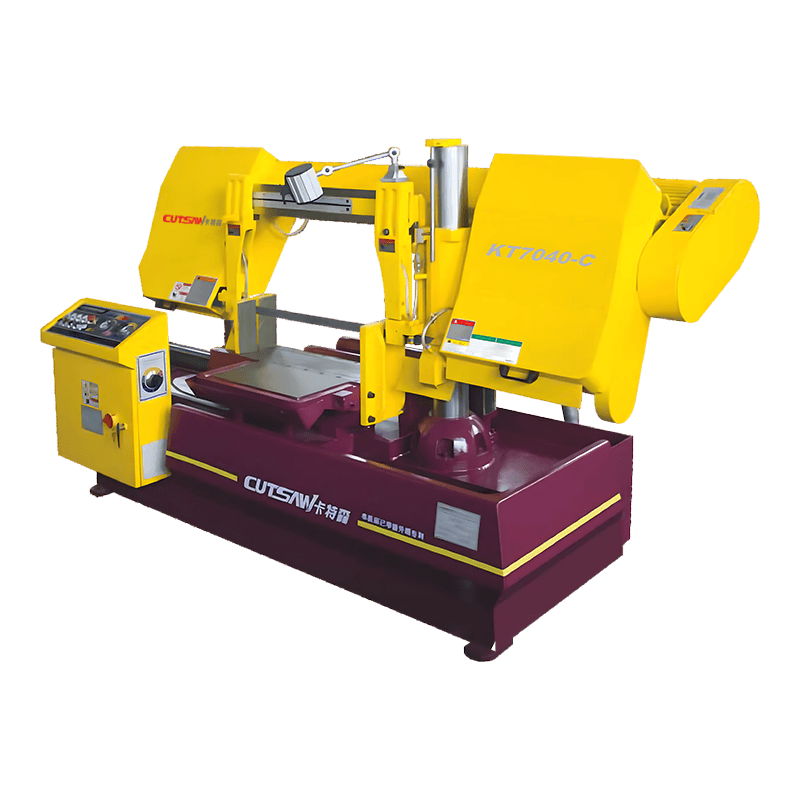 KT7040-C Double-Column Semi-Automatic Metal Band SawA double-column horizontal semi-automatic saw with 400 mm height and 700 mm width capacity and hydraulic clamping, useful for stable cuts without full automatic indexing.View Product →
Capacity, Blade Speed, and the Specs That Actually Matter
Cut capacity and vise opening
Do not compare only the headline round capacity. Check rectangular capacity, bundle width, and the maximum vise opening. A saw that clears a 400 mm round bar may still struggle with a low, wide structural section because the clamping geometry changes. For pipe and tube, confirm roller support and vise jaw options; thin-wall material can deform under excessive clamping pressure.
Blade speed, motor, and feed control
Blade speed should match the material, not the machine’s maximum specification. Stainless and tool steels usually need lower surface speed and controlled feed; mild steel and aluminum can run faster. A hydraulic feed control with fine adjustment is more useful than a single “fast” and “slow” setting. Motor power matters most when cutting large sections continuously, but excessive force without adequate blade tension and coolant delivery shortens blade life.
Miter and pipe work
For angle cuts, look at how the head or vise rotates and how the workpiece is supported after the swivel. A 45-degree cut is not a single feature; it is a setup sequence. On pipe, the operator needs stable support on both sides of the cut and a vise that holds round stock without crushing it. A CE-marked semi-automatic model such as the KT7143HP is relevant when safety compliance, hydraulic clamping, and conventional miter work are part of the specification.
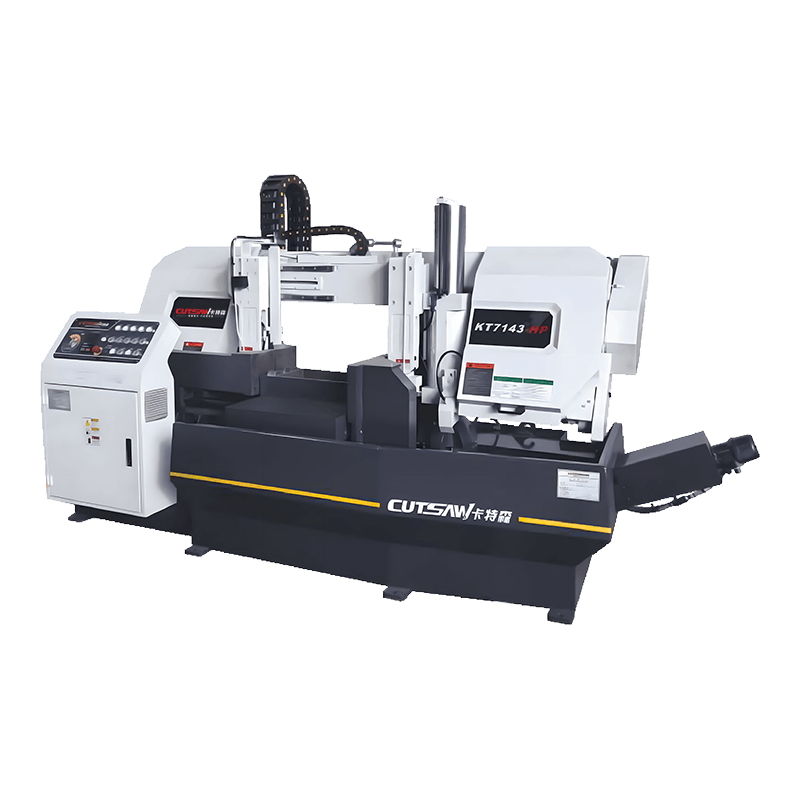 KT7143-HP CE Semi-Automatic Metal Band SawA CE-marked semi-automatic saw with 430 x 710 mm capacity, hydraulic clamping and tensioning, suited when compliance and conventional miter work are specified.View Product →
Pipe-specific buyers should also check the bed height, roller stands, and chip fall zone. A semi-automatic pipe cutting machine such as the KT7040P is designed around that repeated load-and-clamp routine, where the operator advances the pipe and the saw handles the cut cycle.
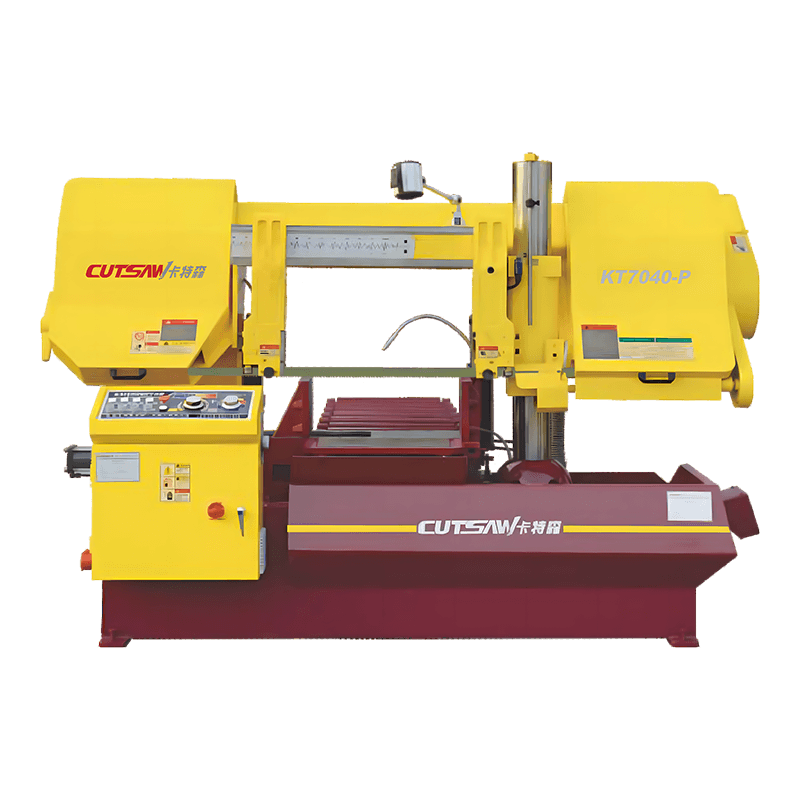 KT7040-P Semi-Automatic Pipe Cutting Band SawA semi-automatic pipe-cutting band saw with 400 x 700 mm capacity, hydraulic clamping and automatic feeding, relevant when repeated load-and-clamp cycles constrain pipe production.View Product →
Semi-Automatic vs. Fully Automatic: A Simple Buying Test
Run a one-week time study before choosing. Record how long the operator spends loading, measuring, clamping, and waiting. If the saw is cutting while the operator is preparing the next piece, the manual load step may not be waste. If the operator stands idle through every cut and then spends another minute indexing stock, the semi-automatic model is already the constraint.
If your operator spends more time walking to the saw than the saw spends cutting, semi-automatic is not the problem. The material flow is.
Fully automatic saws make sense when the same section runs for hours, the cut length is stable, and the shop can keep the magazine loaded. Semi-automatic saws make sense when the next job may be a different alloy, a different diameter, or a miter cut that needs a visual check. The cost difference is not only the machine price; it includes programming time, maintenance skills, floor space, and the discipline needed to keep an automatic magazine fed.
Procurement note: A low-price semi-auto with undersized coolant flow, difficult blade access, or a vise that will not hold short remnants often costs more per cut than a better-equipped model. Ask for a witnessed trial cut on your own material, including the shortest remnant you expect to clamp.
Shop-Floor Setup and Daily Running Costs
Most semi-automatic saw problems start with installation and routine control, not the gearbox. The machine needs a level foundation, stable power, clean coolant, and enough clearance for long stock. Blade tension, guide adjustment, and vise pressure should be checked at the start of each shift. A practical reference on band saw components and their functions helps operators understand which adjustment affects cut squareness and which one only affects blade life.
- Coolant: Mix to the material and water conditions, check concentration weekly, and remove chips before they form a sludge bed.
- Chip removal: Confirm the chip brush and wheel clean the blade flanks; packed chips cause drift and poor finish.
- Blade tension: Follow the blade supplier’s range, then verify with a tension gauge rather than by feel alone.
- Vise pressure: Enough to prevent movement, not so much that thin-wall tube collapses or the clamp marks finished stock.
- Blade break-in: Reduce feed for the first few cuts on a new blade, especially on stainless and hardened material.
Energy use is usually secondary to blade consumption and operator time. A saw that cuts slightly slower but holds squareness and blade life will often cost less per finished piece than a fast machine that needs frequent blade changes and rework.
A Practical Procurement Checklist
Before issuing a purchase order, ask for these details in writing:
- Maximum round, square, and rectangular capacity, plus the maximum vise opening.
- Blade size, recommended blade speed range, and motor power.
- Vise type, clamping force adjustment, and support for short remnants.
- Miter range and the setup method for common angles.
- Coolant system, chip removal, and access for cleaning.
- Safety guards, emergency stop, and electrical compatibility for the destination market.
- Acceptance cut: material grade, section, cut length, squareness, and surface finish.
- Spare parts list, blade supply, and operator training scope.
The Bottom Line
A semi-auto band sawing machine is a production tool for shops that need repeatable cuts without giving up operator control. It fits mixed lots, miter work, pipe cutting, and maintenance departments where material changes faster than an automatic magazine can be reloaded. It is the wrong choice when the same section runs continuously and the operator is merely waiting for the head to rise.
Match the machine to the cut mix, verify the vise and support details, and test the saw with your own material. The most useful specification is not the largest capacity on the brochure; it is the cut that your operator can load, clamp, and repeat safely through the shift.